
Chapter 1 of 6
Plug sockets in Rhodes: which plugs work?
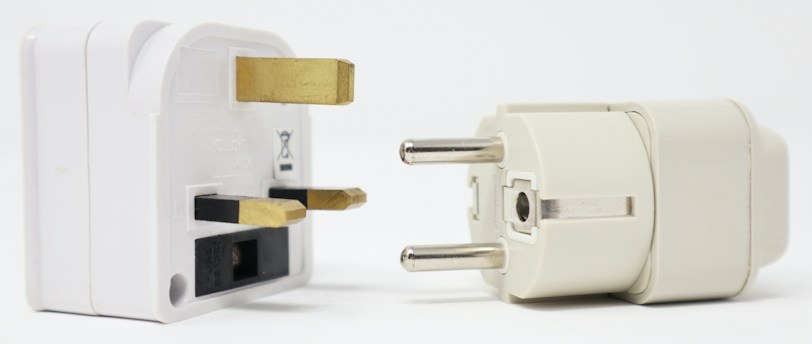
Rhodes, like all of Greece, uses two types of plug sockets: Type C and Type F. Type C has two round pins. Type F, often called a 'Schuko' plug, also has two round pins but includes side contacts for grounding.
My advice is to buy an adapter that is specifically listed as compatible with Greece. Don't get caught out by vague 'European' adapters that don't fit our sockets, as there isn't one single standard across the continent.
- UK and Ireland: Your three-pronged Type G plugs will need an adapter.
- US and Canada: Your Type A and B plugs require an adapter, and you must check the voltage.
- Australia and New Zealand: Your angled Type I plugs definitely need an adapter.
- Compatible Type C or Type F plugs: If your plug already has two round pins in the right format, you won't need an adapter for the shape, but you still must verify the voltage.
Chapter 2 of 6
Adapter or voltage converter: what do you need?
This is the point that causes the most confusion and, occasionally, fried electronics. A plug adapter only changes the shape of the prongs to fit the wall socket. It does not convert our 230V electricity down to 110-120V.
A voltage converter (or transformer) is a different, much heavier device that actually changes the voltage. You'll only need one for specific single-voltage appliances, and it must have the right power rating. Don't just buy a 'travel' converter; check that it's suitable for your device.
For modern items like phone, tablet, camera, and laptop chargers, things are usually simpler. Most are designed for global travel and support a wide voltage range. In that case, a simple plug adapter is all you need. But please, don't assume—always check.
Read the input label, not the output label
You need to find the text marked “Input” on the charger brick or the appliance itself. If it says something like “100–240V, 50/60Hz”, it's compatible with the 230V, 50Hz supply in Rhodes. Then you just need the right adapter.
A common mistake I see is people looking at the 'Output' figures. Those numbers describe the power going to your device, not the power the charger can take from the wall. Always check the 'Input'.
- Input includes 230V and 50Hz: You're good on voltage; now just check the plug shape.
- Input states only 110–120V: Do not use this with a simple plug adapter. You'll likely damage it.
- Label is unreadable or missing: To be safe, check the manufacturer's website or leave it at home.
Chapter 3 of 6
Take extra care with hairdryers and grounded appliances
In my opinion, you should just leave your own hairdryer at home. Heat-producing appliances like hairdryers and straighteners are the number one cause of electrical problems for travellers. Their high power draw can overload a cheap travel adapter, creating a safety risk.
Furthermore, if your device requires an earth connection for safety, a simple two-pin travel adapter won't provide it. Just because the plug fits doesn't mean it's safe. An earthed socket is only effective if your plug and adapter maintain that connection.
Check the whole connection
I tell people to think of it as a chain. You must compare your appliance’s power needs with the adapter’s maximum rating. If you're using a converter, you have to check its power limit too. Never exceed the rating of any single component in that chain.
If your appliance has a little red switch to select the voltage, you must set it to the 220-240V position before you plug it in. An adapter will not do this for you.
When leaving it at home makes more sense
For a high-power appliance designed only for 110-120V, the smartest and safest choice is to leave it behind. Most hotels and many rentals provide a hairdryer. I would always recommend asking your accommodation about this instead of risking your own device.
If you have any doubt about voltage, grounding, or power load, my advice is simple: don't plug it in. It's not worth the risk.
Chapter 4 of 6
Plan your charging without relying on hotel extras
My firm advice is to bring the adapters you need. Don't arrive assuming your hotel reception will have a box of spares for you to borrow. Some do, but it’s a gamble you don’t want to take with a dead phone.
A multi-port USB charger is a great idea for charging several devices at once, but you must still confirm its input rating is compatible with our 230V supply. This is very different from plugging a multi-socket extension lead from your home into a single travel adapter—that is a bad idea.
Please do not try to solve an incompatibility by stacking adapters or using an extension lead from home. The entire setup must be rated for our supply and the total load. It’s a fire hazard otherwise.
And once your phone is charged, make sure your mobile plan is ready for your trip. I've covered that topic in my guide to Wi-Fi, roaming and SIM options in Rhodes.
I suggest packing your adapter right next to your chargers. My full Rhodes packing list helps you remember all your electronics.
Chapter 5 of 6
What to do if you forget your adapter
It happens to the best of us. If you get here and realize you forgot your adapter, first ask at your accommodation's reception. They may have one to lend you or can tell you where the nearest electronics or tourist shop is.
If you have to buy one, I recommend taking your device's charger with you to the shop. At the very least, have a clear photo of its plug and input label so you can be sure you're buying the right thing.
Whether it's borrowed or newly purchased, check it just as carefully as you would one from home. Make sure it fits properly, is rated for your appliance, and provides grounding if needed. Never force a plug that doesn't fit.
This is why I always say it's better to buy your adapter before you travel. You can check it at your leisure and avoid a last-minute panic on arrival.
Chapter 6 of 6
Your final electrical packing check
Before you close your suitcase, I'd suggest running through this quick check for every electronic device you're bringing. It's a simple step that can save a lot of trouble.
If you have more questions about practicalities like phones, language, or money, have a browse through my main Rhodes practical travel questions hub. I've done my best to answer everything there.
- Plug: Does it fit our Type C/F system, or have I packed the right adapter?
- Supply: Is the input rated for 230V at 50Hz?
- Grounding: If my appliance needs an earth connection, does my adapter preserve it?
- Load: Are the adapter and any converter I'm using rated for this specific appliance?
- Fallback: Have I left unsuitable high-power items at home and checked if my hotel provides them?
Sources and product information
Frequently asked questions
What plug type is used in Rhodes?
Here in Rhodes, we use the same Type C and Type F sockets as the rest of Greece. Both use two round pins, and the electricity supply is 230V at 50Hz. You'll need an adapter if you're coming from the UK, Ireland, the US, or Australia.
Will an adapter I used elsewhere in Europe work in Rhodes?
It might, but I'd advise you to check it carefully. There isn't a single plug standard for all of 'Europe'. As long as your adapter is for the Type C/F system we use in Greece and is correctly rated for your device, you should be fine. Don't just assume it will work.
Does a universal travel adapter also convert voltage?
In my experience, almost never. You should assume it doesn't. 'Universal' usually refers to the adapter's ability to accept plugs from many different countries, not its ability to change voltage. A voltage converter is a separate, bulkier item.
Do I need a different adapter for Rhodes and mainland Greece?
No, you don't. The electrical system is identical across all of Greece—Rhodes, the other islands, and the mainland. We all use the same Type C/F plugs and 230V, 50Hz supply. One adapter for Greece is all you need.