
Chapter 1 of 8
Is Faliraki Beach right for you?
Faliraki Beach is a good choice if you want a long sandy beach with food, drinks and a lively central atmosphere close at hand—not a secluded-cove experience. It suits families, social beachgoers and travellers who want a straightforward beach day without making every swim or lunch stop an expedition. Families should choose their swimming spot carefully, though: the appeal of the sand and gentler entry still needs to match the conditions where you actually enter the water.
Who will enjoy it most
Faliraki’s biggest strength is convenience. You can spend the day on the sand with cafés, restaurants and beach activities nearby, which makes it particularly appealing for first-time visitors and groups with different ideas of a good beach day.
It is also a practical sandy-beach option for travellers coming from Rhodes Town, Ixia, Ialyssos or Kallithea. If you are weighing sand, scenery and atmosphere across the island, the Rhodes Island Guide’s beach section helps put that choice in context.
- Families with children: sand for playing and places with a gradual sea entry are the main attractions, alongside easy food breaks. I’d choose the swimming spot before settling down, checking the entry, waves and nearby activity rather than relying on a blanket “family-friendly” label.
- Social beachgoers: the central beach has music, beach bars and people-watching. It suits couples, friends and solo travellers who like some energy around them during the day.
- Travellers who value simplicity: Faliraki works well when the plan is swimming, relaxing and finding lunch nearby, rather than seeking out a remote beach.
- Mixed-interest groups: water sports and beachfront places to eat give more active companions something to do without everyone needing to commit to the same activity.
- Sand lovers: if pebbles are what usually put you off a beach day in Rhodes, Faliraki’s long sandy shoreline is a strong reason to choose it.
Who might prefer another beach
If your ideal beach day means silence, untouched surroundings and very few people, Faliraki would not be my first recommendation. Quieter corners offer a compromise, but you are still choosing a popular, developed beach; the centre can feel busy, particularly in July and August.
The same applies if dramatic rocky scenery or snorkelling is your main reason for going. Faliraki’s strength is an easy sandy beach day, not an intimate bay setting; for a different kind of visit, compare it with Anthony Quinn Bay.
My suggestion: choose Faliraki when convenience matters more than seclusion. If peace and a tucked-away setting are the whole point of your day, choose a beach that fits that brief rather than spending your visit trying to escape Faliraki’s atmosphere.
Chapter 2 of 8
Which stretch of Faliraki Beach should you choose?
Choose central Faliraki Beach for music, a social atmosphere and food close to the sand; look towards the quieter edges if you would rather have more space and less activity around you. The useful distinction is lively centre versus quieter stretches, rather than a rigid set of beach zones. Before settling down, compare the music, neighbouring activity and shoreline at the spot you actually want to use.
The lively central stretch
Central Faliraki is the strongest choice if you want a sociable beach day with everything close by. Beach bars, cafés, restaurants and shops behind the sand give this stretch its busy, convenient feel, with water-sports activity adding to the atmosphere.
It suits couples, groups and solo travellers who like people-watching and an easy switch between swimming, drinks and lunch. The appeal is daytime energy rather than somewhere to escape all noise; if reading in peace is your priority, I’d look beyond the busiest cluster of bars before choosing a spot.
- Choose it for convenience: food and drinks are close at hand, so you need less planning for a longer stay.
- Look around before settling: check where music is coming from and how much activity there is beside your chosen spot.
- Check the shoreline too: choose somewhere you are comfortable entering the water, rather than deciding solely on the sunbed setup.
Looking for a quieter spot
Away from the central bustle, Faliraki has quieter stretches with more breathing room. These are a better starting point for relaxed couples, families who prefer less music, and anyone who wants the sand without the full beach-bar atmosphere.
My suggestion: move away from the busiest bars and compare a few spots before unpacking. With children, I’d balance quieter surroundings against the convenience of nearby food and drinks, then look at the water’s edge itself rather than choosing somewhere simply because it feels more family-oriented.
The quieter edges are still part of a popular resort beach, so choose them for a calmer version of Faliraki rather than complete seclusion. If solitude is the main aim of your day, the Rhodes Island Guide’s beach chooser can help you compare other options.
Keeping the main beach separate from nearby bays
Kathara Beach and Mantomata Beach are separate nearby beaches, not quieter sections of the main Faliraki beachfront. Kathara lies south of central Faliraki, with Mantomata farther beyond it.
Keep that distinction in mind when choosing where to spend the day: moving along the main beach and heading to another bay are different decisions. Use the Map of Rhodes to orient yourself; the nearby-beaches chapter covers those separate stops.
Chapter 3 of 8
What are the sand and swimming like?
Yes—Faliraki Beach is sandy, with soft golden sand along most of the main beach and a generally sandy seabed with a gradual entry. That makes it a good choice for paddling and relaxed swimming, but the depth, footing and waves at your actual entry point matter more than the beach’s family-friendly reputation.
Sand and sea entry
Faliraki’s main appeal is sand underfoot rather than a predominantly pebbly shoreline. The generally gradual slope gives you room to ease into the sea, which suits travellers who prefer a gentle entry to stepping straight into deeper water.
Before swimming, walk into the water slowly and check how quickly it deepens where you are. Look at the bottom where visibility allows, test your footing and choose an exit you can comfortably use again; a sandy beach does not mean every entry point feels identical.
Water clarity is generally good, especially when the surface is calm, but clear-looking water is not a measure of bathing-water quality. For an easy sandy swim, Faliraki is a strong choice; if seeing marine life is your priority, use the Rhodes snorkelling guide to choose a spot suited to that.
- Check the sand and footing at the waterline, not just the dry beach.
- Test the slope close to shore before taking children or less-confident swimmers farther out.
- If waves or disturbed sand make the bottom difficult to judge, choose an easier entry or wait.
Choosing a swimming spot with children
Faliraki’s soft sand and generally gradual entry make it a practical family option, but choose conditions to suit the weakest swimmer in your group. I’d prioritise an easy entry, manageable waves and a clear view of the children over being beside the busiest beach facilities.
Supervise children continuously in and around the water, keeping young children and non-swimmers within arm’s reach. Shallow water is a place for supervised paddling, not a substitute for swimming ability, and flotation toys are not safety equipment.
Look for enough space to keep your group together without drifting towards an active water-sports area. If the conditions are beyond anyone’s comfort level, keep the visit to sand play or choose another beach using the Rhodes Island Guide’s beach-selection advice.
- Have a capable adult assess the entry before the children go in.
- Agree which adult is watching the children rather than sharing responsibility vaguely.
- Keep paddling and swimming away from active launch areas, even when the water beside them looks inviting.
- Reassess the spot if waves, visibility or nearby activity change.
Wind, waves and water-sports traffic
Faliraki sits on Rhodes’ more sheltered east coast and often offers gentle swimming conditions. Sheltered does not mean permanently calm: watch the waves at the shoreline and how swimmers are managing before deciding to enter.
The sea is generally warmest for swimming through June–September, with May feeling fresher and pleasant swimming often continuing into October. Your comfort will still depend on the day’s weather and your own tolerance, so judge the water itself rather than the calendar.
Water-sports stations operate along the central beach, making traffic another part of choosing a swimming spot. Keep clear of places where jet skis, tow boats, pedalos or other craft are launching and returning, and use designated swimming areas where marked.
- Follow posted warnings and any lifeguard or operator instructions.
- If a marked corridor’s purpose is uncertain, ask before entering rather than swimming across it.
- Choose somewhere else to swim if you cannot keep comfortably clear of moving craft.
- Get out if the conditions become harder than the weakest swimmer can manage.
If you want to add an activity, compare water-sports options and ask the operator about swimming ability requirements and conditions before booking.
Chapter 4 of 8
What should you expect for sunbeds, shade and costs?
For sunbeds at Faliraki Beach, the useful question is not just “How much?” but “What does that cover?” Central Faliraki has organised sunbed areas and beach service, but agree the full charge, check the shade and locate any essential facilities before paying for your chosen spot.
Checking the sunbed price
Check the current price with the operator rather than budgeting around an older online sunbed listing. A headline charge is only useful once you know whether it covers one person, one lounger or a complete set.
My suggestion: ask for the total for your whole group before settling in, especially if you need an extra lounger. If the price or spending rules aren’t explained clearly, choose another setup.
- Is the charge per person, per lounger or per set?
- How many loungers are included, and does the price include an umbrella?
- Is there a separate rental charge, a minimum food-and-drink spend, or both?
- Are any drinks included, or does “drinks service” simply mean you can order from your lounger?
- How long does the payment cover, and can you leave for lunch and return to the same beds?
Umbrellas and your own shade
An organised umbrella-and-lounger setup suits travellers who want less to carry and somewhere comfortable to spend the day. Check the actual arrangement at the spot you choose: shade and service need to work for your group, not just look appealing from the promenade.
For a quieter, towel-on-the-sand day, bring your own shade rather than relying on finding an umbrella at the beach’s edges. Ask where you can set up clear of rented loungers and access routes, and secure a portable umbrella properly; take it down if the wind makes it unstable.
I’d prioritise dependable shade over the cheapest setup if you’re travelling with young children or anyone who needs regular breaks from the sun. If space for your own setup is a deciding factor, the Rhodes Island Guide’s beach chooser can help you compare beach-day styles.
Toilets, showers and changing needs
Ask which toilets, showers and changing facilities serve your particular sunbed area before paying. Nearby cafés and restaurants make central Faliraki convenient, but access to their facilities is a separate question from renting a lounger.
If these facilities are essential, I’d locate them first rather than accept a vague “nearby.” For families, anyone with limited mobility or anyone needing a private place to change, the route and access arrangements matter as much as the distance.
- Toilets: where are they, are they open, and is access included or restricted to customers of a particular venue?
- Showers: is there a working rinse-off shower serving this area, and is there an extra charge?
- Changing: is there a dedicated private changing space?
- Accessibility: are there steps or stretches of loose sand on the route, and does the toilet meet your needs? Use the accessible beaches in Rhodes guide for wider planning, then ask about the exact setup you intend to use.
Chapter 5 of 8
How do you get to Faliraki Beach from Rhodes Town?
Take bus 40, the Rhodes–Kallithea Avenue–Faliraki route, for a beach day from Rhodes Town without renting a car. I’d choose a car if you want several beach stops or more freedom over your return time; for Faliraki Beach alone, it isn’t a necessity.
Bus 40 via Kallithea Avenue
Bus 40 connects Rhodes with Faliraki via Kallithea Avenue and is listed as running Monday–Sunday. It’s the route to look for if you’re staying in Rhodes Town and want to spend the day at Faliraki without dealing with parking.
Services change seasonally, so use the Rhodes Island Guide’s bus-planning advice to check current departures, your Rhodes Town boarding stop, the best Faliraki arrival stop for your chosen beach entrance, the fare, walking directions and the return journey together. Save those details before setting off so you can enjoy the beach without having to work out the journey home later.
When a rental car makes sense
My suggestion: choose Rhodes car rental if Faliraki is one stop in a day involving several beaches, such as Ladiko and Anthony Quinn Bay. A car gives you control over how long you stay at each stop, while a single-beach day is easier to build around the bus.
The drive from Rhodes Town takes roughly 20 minutes, with traffic and your exact destination affecting the journey. When comparing car hire options, look at the collection location, insurance terms and fuel policy as well as the headline price.
If you’re arriving by air and heading straight to Faliraki, Rhodes airport transfers are a separate option for that airport journey.
Arrival, parking and accessible beach entry
Choose your beach entrance before setting your navigation, rather than using a general Faliraki pin. The beach stretches for around five kilometres, so arriving in the resort and arriving beside your chosen patch of sand can mean different things.
For parking, follow signs at your chosen access point and read any displayed charges or restrictions before leaving the car. Check the walking route between the space and the beach, especially if you’re carrying children’s gear or need to minimise walking.
If you have mobility needs, start with accessible beach planning in Rhodes and confirm the arrangements at the exact entrance you intend to use. Ask about step-free access from the stop or drop-off point, the surface leading onto the sand, accessible toilets and any assistance needed to reach the water.
A taxi is another option if you want to avoid the bus journey without hiring a car. Give the driver your chosen beach entrance or a nearby named venue, and check that the meter is running.
Chapter 6 of 8
What can you eat and do during a beach day?
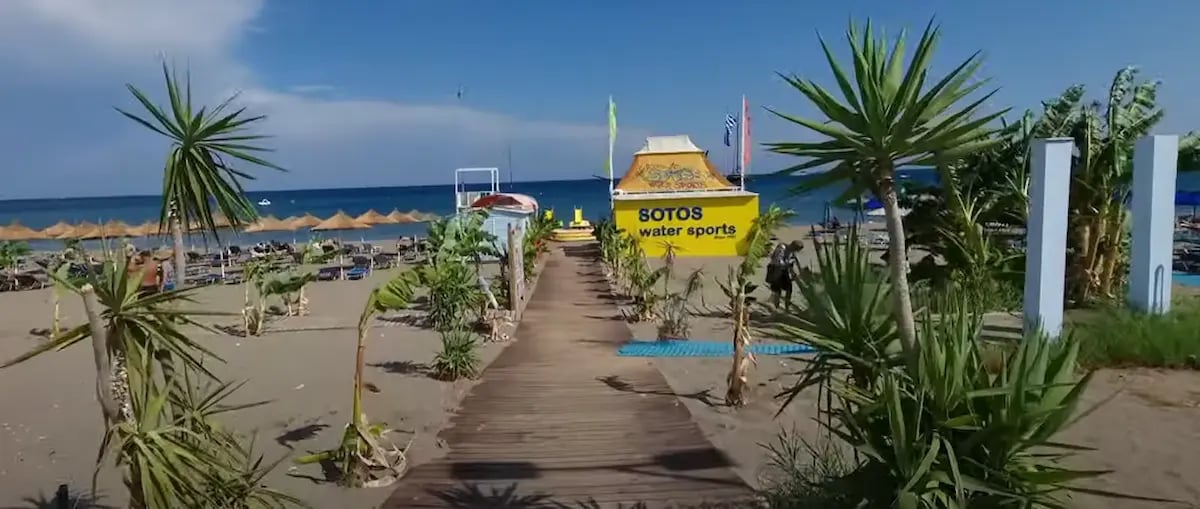
Faliraki Beach makes it easy to combine swimming with a beachfront lunch, coffee or cocktails, plus a water-sports session if you want something more active. You can keep it simple with a gyros between swims or settle in for a proper meal; there’s no need to turn the day into a packed activity itinerary.
Beachfront food and drinks
The central beachfront is the convenient choice for a meal without going far from the sand. Restaurants serve seafood, salads, grilled dishes and pasta, while beach bars add cocktails and a livelier atmosphere; that suits a social lunch better than a quiet conversation away from music.
For a more relaxed sit-down meal, I’d look towards the southern end and the Kathara area, where traditional tavernas offer more local-style cooking. That’s a useful option for families or anyone who wants lunch to feel like a break from the busy central strip.
- For a quick bite: gyros, toasties and pastries let you keep lunch simple between swims.
- For coffee or a snack: cafés are plentiful around the beach area, so you don’t need to commit to a full restaurant meal.
- For a longer lunch: choose a beachfront restaurant for a broad menu, or a southern-area taverna for a quieter, more traditional meal.
- For drinks by your lounger: some beach clubs offer drinks service at the sunbeds. Ask how orders are charged and what, if anything, is included before settling in.
Choosing a water-sports activity
Water-sports stations are concentrated along the central beach, with options including parasailing, jet skiing, banana boats, tube rides, stand-up paddleboards and pedalos. I’d choose by the experience you want—not just the headline price—and ask what is operating in the day’s conditions.
Before paying, get clear answers about the activity’s duration, equipment, age requirements and operating conditions. For families, explain the children’s ages and swimming ability so the operator can advise on suitability.
- For a slower-paced outing: consider a pedalo or stand-up paddleboard. Ask about the permitted area, return arrangements and whether the wind and sea conditions suit your experience.
- For speed or a livelier group activity: compare jet skiing, banana boats and tube rides. Check participation requirements, the safety briefing and what protective equipment is supplied.
- For a view above the coastline: ask about parasailing. Clarify actual time in the air versus the total outing, along with participant restrictions and weather-related cancellation arrangements.
- For any activity: confirm whether the price is per person or per craft, how much active time you get, and whether equipment and instruction are included.
My suggestion: leave most of the day free for swimming and relaxing, and pick one activity you’re excited about. If you’d rather arrange it ahead of time, use the Looneytravels Booking Marketplace as an optional starting point and check the listing’s location, inclusions and availability.
Chapter 7 of 8
When should you go, and what should you bring?
I’d arrive earlier in the day at Faliraki Beach so you have time to compare a few spots before settling down—not because an early arrival guarantees an empty beach. Bring sun protection, drinking water, a towel and comfortable footwear, plus a few essentials to keep children comfortable between swims.
Choosing your arrival time
My suggestion: leave yourself time for a short look along the beach before unpacking. That’s particularly useful with children or if music and a social atmosphere aren’t what you want; choosing somewhere you actually like matters more than arriving at a particular hour.
Midday is generally the busiest, liveliest part of the beach day, while late afternoon brings softer light and cooler sand—an appealing option for a shorter visit or photos. Morning also offers good light, especially towards the beach’s edges, but neither end of the day promises solitude.
Faliraki gets crowded in July and August, so an earlier start is breathing room for your own plans rather than a way to avoid summer crowds altogether. If you’re still deciding when to take your holiday, use the Rhodes Island Guide’s advice on when to visit for the wider seasonal picture.
Packing for your beach day
Keep your bag practical: cover sun protection, drinking water and comfort outside the sea before adding extras. For the rest of your holiday preparation, the practical tips for visiting Rhodes are a useful companion.
- Sun protection: sunscreen, a hat, sunglasses and a light cover-up. If you plan to spread out on the quieter edges, consider bringing a lightweight beach umbrella.
- Drinking water: bring enough for your planned stay, especially if you want to settle away from the central strip.
- A towel: pack one for each person, including children who will be getting in and out of the water.
- Suitable footwear: sandals or flip-flops for the beach, and comfortable walking shoes if your day includes more walking.
- Children’s dry-time essentials: spare dry clothes, sun hats, snacks and a small toy or activity for breaks outside the water.
Chapter 8 of 8
Which nearby beaches are worth a separate stop?
Kathara, Mantomata, Ladiko Beach and Anthony Quinn Bay are nearby options worth considering, but they are separate destinations—not stretches of the main Faliraki Beach. Choose Mantomata for a naturist setting, Ladiko for a small-cove atmosphere, or Anthony Quinn Bay for rocky scenery and snorkelling; Kathara also puts you near traditional tavernas for a quieter meal. If you're still deciding which beach suits you, start with my Rhodes beaches guide.
Kathara and Mantomata
Kathara Beach lies south of central Faliraki, before Mantomata. The Kathara area has traditional tavernas serving more local-style cooking, making it a useful option for families or anyone wanting a quieter meal away from the central strip.
Mantomata is a naturist beach beyond Kathara, with a peaceful atmosphere and a respectful naturist community. Its shore mixes soft sand with small stones, and the clear water and quiet sunbathing spots offer a different setting from central Faliraki.
I'd choose Mantomata specifically for that naturist atmosphere, rather than simply because it sounds quieter. If you prefer a beach without a naturist setting, pick another stop; if you do visit, respect other beachgoers’ privacy.
Ladiko Beach and Anthony Quinn Bay
South of Faliraki, Ladiko and Anthony Quinn Bay make good alternatives when you want a cove rather than a long sandy beach. Give your chosen beach its own stop and plan access separately, rather than building the day around a coastal walk linking them all.
- Ladiko Beach is small, cosy and particularly appealing for couples who prefer an intimate setting. It is also a lovely sunrise option; use its dedicated guide for beach-day planning.
- Anthony Quinn Bay is the stronger choice for dramatic rocky scenery, emerald water and snorkelling. Paths around the bay can be steep, so it is less appealing if you want to avoid uneven walking; its own guide covers the practical details.
My suggestion: Choose one additional stop rather than rushing through several. A proper swim at one nearby beach adds more to your day than a string of quick arrivals and departures.
Book transport and beach activities
water sportstransfersFrequently asked questions
Is Faliraki Beach sandy?
Yes, Faliraki Beach is a sandy beach. Check the entry where you choose to swim rather than expecting every part of a long shoreline to feel identical underfoot.
Is Faliraki Beach good for families?
It can be a good choice for a family beach day, particularly if you prefer sand and a lively setting. Choose your spot around the conditions that day, keep children closely supervised and stay clear of water-sports activity.
How much are sunbeds at Faliraki Beach?
Check the displayed charge or ask the operator before settling in. Make sure the quote covers what you need: one lounger or a pair, an umbrella, and any separate food or drink minimum.
How do you get to Faliraki Beach from Rhodes Town?
Bus 40 is the Rhodes–Kallithea Avenue–Faliraki route. Before using it for a beach day, check the seasonal departures, beach-access stop, fare and return journey. I’d choose a car instead if the plan includes several beaches.
Which part of Faliraki Beach is quieter?
The source describes a lively centre and quieter edges. If quiet is your priority, look beyond the central stretch and choose a spot away from music and water-sports activity rather than relying on a fixed beach zone.
Is the water always calm at Faliraki Beach?
No beach offers guaranteed calm conditions. Look at the water and any safety notices before swimming, and choose your entry to suit the least confident swimmer in your group.
Is Mantomata part of the main Faliraki Beach?
Mantomata is a separate nearby beach associated with naturist bathing, not a general description of Faliraki’s main beach. Keep that distinction in mind when choosing your destination.
Can you walk along the coast to Ladiko and Anthony Quinn Bay?
Plan Ladiko and Anthony Quinn Bay as separate beach stops rather than building your day around a continuous shoreline walk. If you want to visit several beaches, I’d arrange transport and leave enough time to enjoy each one.