
Chapter 1 of 10
What was Rhodes like before Rhodes city existed?
Rhodes was inhabited long before Rhodes city was founded in 408 BC. Its earlier history centres on prehistoric communities, Aegean trade and three separate city-states: Lindos, Kamiros and Ialysos.
The island's early settlements
The history of Rhodes island begins with settlement in the Neolithic period, well before its ancient cities developed. The founding of Rhodes city marks a much later turning point, not the beginning of life on the island.
During the Bronze Age, Rhodes was part of the Aegean trading network. Minoan influences from Crete and Mycenaean influences from mainland Greece helped shape its early history. Finds of pottery and tools show connections between Rhodes and the surrounding world.
The sea connected these early communities with other places. Trade was already part of island life before Rhodes had a single shared capital.
Lindos, Kamiros and Ialysos
In the Dorian period, Lindos, Kamiros and Ialysos became the island's three major city-states. They were separate political communities, each with its own government, temples and markets. Think of them as centres of island life, rather than districts of an existing Rhodes city.
These three names matter because Rhodes developed around several centres before their union. Their union was followed by the founding of Rhodes city in 408 BC. That is the key dividing line between the island's earlier city-states and the story of its new capital.
If this earlier history interests you, I'd start with Ancient Kamiros. It gives you a place to connect with the island's ancient city-state history beyond Rhodes Town. Use the Rhodes itinerary ideas to fit that visit into your wider island plans.
Chapter 2 of 10
Why was Rhodes city founded in 408 BC?
Rhodes city was founded in 408 BC after Lindos, Kamiros and Ialysos united to create a shared capital. This date marks the founding of the city, not the island’s first settlement.
The union of the three city-states
Before Rhodes city existed, Lindos, Kamiros and Ialysos were separate city-states, each with its own political system. Their union brought them together, with a new capital on the island’s northern tip. That is the key to understanding 408 BC: existing communities joined together, rather than settlers arriving on an empty island.
The new city’s harbour gave it a strong position for sea trade and naval activity. Rhodes developed into an important trading and cultural centre, attracting merchants, scholars and travellers. Its foundation was a turning point in how the island was organised.
If you want to connect these names with somewhere you can visit, explore Ancient Kamiros. It helps you look beyond Rhodes Town and understand that the island’s history also belongs to its older cities.
The new city's Hippodamian plan
Rhodes city followed the Hippodamian system of town planning. In plain English, this means a planned grid, with streets crossing at right angles to form regular blocks. Think of an organised street layout rather than lanes developing little by little.
The name describes the planning system; it is not a reason to credit Hippodamus personally with designing Rhodes. The important point is that the new capital had a deliberate layout from the start.
For a connection with the ancient city, I’d start with the Acropolis of Rhodes at Monte Smith. It suits you if you want to understand Rhodes beyond its medieval walls. Keep the two periods separate: the city founded in 408 BC came long before the Knights and the Old Town buildings you see today.
Chapter 3 of 10
Where does the Hellenistic period fit in Rhodes history?
The Hellenistic period sits after Rhodes city’s foundation in 408 BC and before its Roman period. It was a time when Rhodes became a powerful centre of sea trade, with wealth and independence worth defending.
Rhodes after the city's foundation
By the Hellenistic period, Rhodes city was already established. Its harbour supported trade, naval power and connections across the eastern Mediterranean.
This was the world of rival kingdoms that followed Alexander the Great. Rhodes successfully resisted the siege of Demetrius Poliorcetes in 305–304 BC, defending its independence against a powerful opponent.
The useful thread to remember is trade, wealth and political pressure. This chapter of Rhodes history comes before the Roman period, and long before the medieval city of the Knights.
Historical images and the ancient city
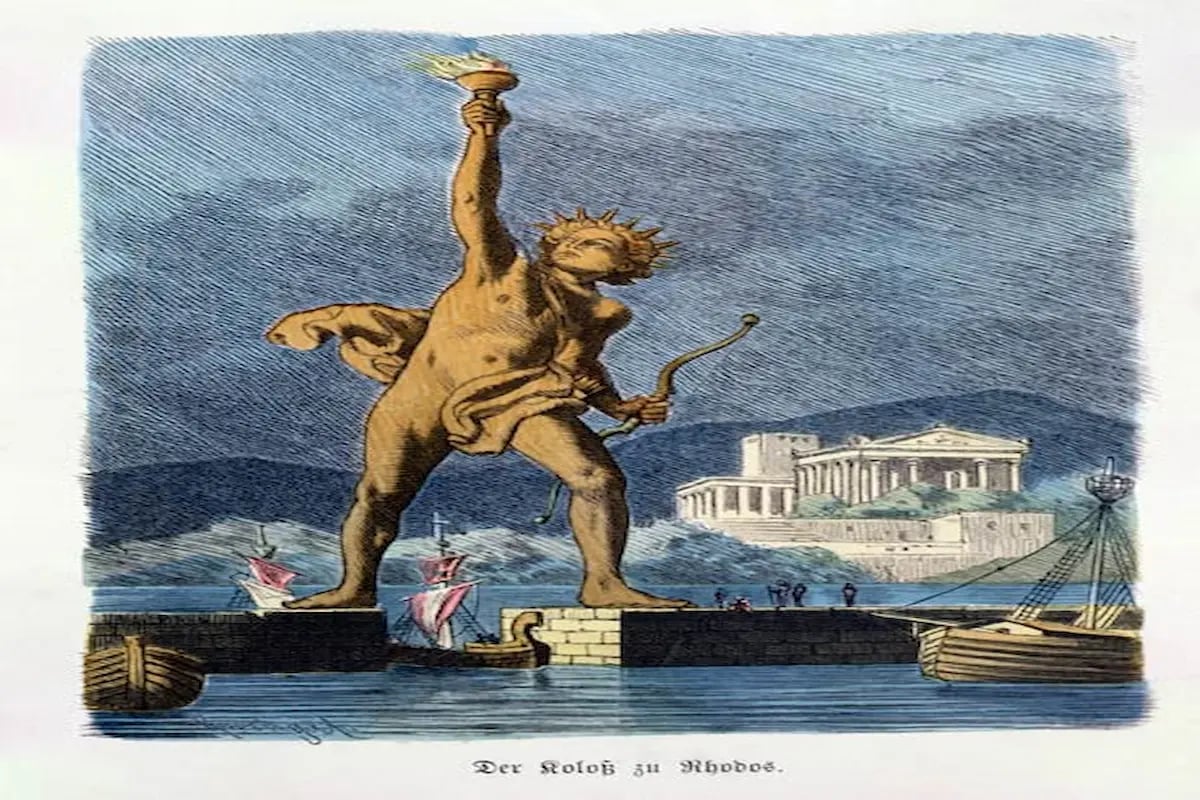
The Colossus often dominates pictures of ancient Rhodes, but an imaginative illustration cannot show you how the city actually looked. Keep that distinction in mind when using historical artwork to picture the harbour and streets.
Image caption: An imaginative illustration of the Colossus of Rhodes, not a reconstruction of ancient Rhodes.
For a connection with the ancient city, I’d choose the Acropolis of Rhodes at Monte Smith. Its ancient remains and sea views give you a landscape to explore beyond the illustration.
Keep the wider timeline in mind as you plan: ancient Rhodes and medieval Rhodes belong to different chapters. Use the Rhodes Island Guide to fit historical stops into the rest of your holiday.
- Social-image description: An imaginative depiction of the Colossus of Rhodes; this artwork is not a reconstruction of the ancient city.
Chapter 4 of 10
What happened in Rhodes before the Knights arrived?
Rhodes passed through Roman and Byzantine rule between its ancient Greek period and the arrival of the Knights Hospitaller. Byzantine walls already defended the city before the Knights settled in Rhodes in 1309 and expanded them.
Rhodes under Roman rule
Under Roman rule, Rhodes remained a centre of education and trade, keeping more independence than many other regions. Romans valued its schools of philosophy, navigation and rhetoric—the art of persuasive speaking.
Trade continued to support the island, while new buildings and public works added to the city. Early Christian communities also appeared during this period, before Christianity became central to Byzantine life.
If you want more than a walk past ruins, I'd combine sightseeing with a museum visit. Explore the museums in Rhodes to choose where to look more closely at the island’s different historical periods.
Byzantine Rhodes and its walls
After the Roman Empire divided, Rhodes became part of its eastern half, known as the Byzantine Empire. Churches and monastic traditions developed, while fortifications helped defend the island and the eastern Aegean.
Pirate attacks threatened coastal communities, and many settlements moved inland for safety. Defence therefore shaped more than the capital: it also influenced where people lived across the island.
The key connection with the medieval city is its walls. Much of the Old Town’s early defensive layout took shape during the late Byzantine period. The Knights later enlarged those existing defences rather than starting with an unfortified city.
Keep that earlier layer in mind when you explore Rhodes Old Town. Its familiar medieval appearance belongs to a longer story, with Byzantine foundations beneath the Knights’ later changes.
Chapter 5 of 10
How did the Knights of Rhodes change the city?
The Knights Hospitaller settled in Rhodes in 1309 and expanded the existing Byzantine walls, shaping the fortified medieval city you see today. Their work transformed its defences, but not every surviving feature belongs to their time.
The Knights Hospitaller arrive in 1309
The Knights Hospitaller, Knights of Saint John and Knights of Rhodes all refer to the same order here. They settled in 1309, taking over a city that already had Byzantine fortifications.
Their arrival marked a major change in the city’s role and appearance. Rhodes became a key stronghold against the Ottoman Empire, and strengthening its defences became central to the Knights’ work.
Expanding the Byzantine defences
The Knights did not build the fortified city from nothing. They expanded the existing Byzantine walls and added substantial defensive works, including towers and gates.
Think of these features as parts of one defensive system, not simply impressive stone landmarks. The walls enclosed the city, while its towers and gateways helped protect it and control entry.
These defences faced real attacks: the Knights repelled an Ottoman siege in 1480. That history gives the walls more meaning when you walk beside them. Their scale served a military purpose, not just the grand appearance that draws travellers today.
Understanding the medieval city
The Knights gave Rhodes much of its strong medieval character, but Old Town contains several historical layers. Earlier Byzantine work, later Ottoman additions and Italian-era restoration all contribute to what survives.
The Medieval City of Rhodes became a UNESCO World Heritage Site in 1988. It is also still lived in, so you are exploring a neighbourhood as well as a historic fortified city.
I’d make time for the streets as well as the major monuments. Stone lanes, arches and courtyards help you understand the city beyond individual buildings. For walking and sightseeing details, explore Rhodes Old Town.
This is a rewarding stop if you enjoy understanding history through the streets around you. If you prefer a focused visit, choose a short walk rather than trying to cover every lane. You can fit it into your wider holiday using the Rhodes Island Guide.
Chapter 6 of 10
What do the palace and Street of the Knights tell you?
The Palace of the Grand Master was the Knights’ administrative centre, while the Street of the Knights housed inns organised by language. Together, they show how one Order brought different language groups under a shared administration.
The Order's administrative centre
The Palace of the Grand Master served as the administrative centre of the Order of the Knights of Saint John. These were the Knights Hospitaller, also known as the Knights of St. John. Think of the palace as the centre of their organisation, not simply an impressive fortress.
That role helps explain a side of the Knights that their walls and towers cannot show alone. Defence was only part of their story: the Order also needed an administration. Looking at the palace with that in mind makes it more than a backdrop for photographs.
Inside, the first floor contains mosaic floors from monuments elsewhere on Rhodes and a collection of medieval furniture. For tickets, opening hours, exhibition availability and detailed access advice, see the Palace of the Grand Master.
Inns organised by language
The Street of the Knights housed inns for the Order’s language groups, known as “langues”. These buildings make an important point: the Knights were not one uniform national group. Their organisation brought together members with different languages.
Read the street as part of that organisation, rather than simply a row of medieval buildings. The separate inns show the language-based groups; the palace represents their shared administrative centre. This contrast helps you understand how the Order was structured.
This pairing particularly suits you if you want to understand the Knights beyond their battles and fortifications. If you mainly want a relaxed Old Town wander, keep the distinction in mind without planning a detailed interior visit. You can fit both landmarks into a wider day using the Rhodes Town planning advice.
My suggestion: look at the Street of the Knights and the palace together, rather than choosing just one. The inns show the Order’s different groups; the palace shows the administration that united them.
Chapter 7 of 10
When did Ottoman rule begin in Rhodes?
Ottoman rule began in 1522, when Rhodes capitulated to Suleiman the Magnificent, ending the Knights’ rule. The city’s history continued under Ottoman control, with new buildings and traditions added to its medieval setting.
Capitulation to Suleiman in 1522
The surrender of Rhodes in 1522 marked the change from rule by the Knights Hospitaller to Ottoman government. The Knights left the island, and Rhodes became part of the Ottoman Empire.
Ottoman rule lasted until 1912. That long period matters when you explore the city: its history did not stop with the Knights.
Rhodes after the Knights
The Ottomans kept much of the existing medieval city while adding buildings for worship, bathing and everyday life. Rather than replacing the Knights’ city entirely, they added another layer to it.
The Greek Orthodox community remained active, maintaining churches and traditions during Ottoman rule. Rhodes developed a mix of Byzantine, Gothic and Ottoman influences that you can still see in Old Town.
My suggestion: explore beyond the Knights’ main landmarks when you plan your walk through Rhodes Old Town. Look at the houses, balconies and smaller streets as well as the fortifications. This is still a lived-in city, not simply a medieval monument.
For the wider cultural picture, explore Rhodes’ folklore and local traditions alongside its buildings. The island’s story includes the communities who continued living here through each change of rule.
- Mosques added new places of worship to the city.
- Hammams, or public baths, and fountains became part of the urban setting.
- Wooden balconies and new residential quarters changed the appearance of its streets.
Chapter 8 of 10
How did Italian rule shape the Rhodes you see today?
Italian occupation shaped both Rhodes’ newer streets and the medieval landmarks you see today. The clearest example is the Palace of the Grand Master, restored in the 1930s: its medieval history is real, but its present appearance also reflects that later work.
Italian occupation and the changing city
Italy took control of Rhodes in 1912 during the Italo-Turkish War. The occupation brought new administrative buildings, paved roads, an expanded Mandraki harbour and tourism infrastructure. Restoration work also changed how parts of the medieval city looked.
Around Mandraki and the New Town, you can still see Italian-era buildings with Art Deco and Neoclassical influences. These streets help explain why Rhodes looks different from many other Greek islands. The Italian legacy is not confined to monuments: it also shaped the city beyond the walls.
My suggestion: combine the palace with a walk around Mandraki rather than keeping your whole visit inside the Old Town. You’ll see both sides of this period—restoration of older landmarks and construction of newer buildings. For fitting that walk into your holiday, explore the Rhodes Town planning advice.
The palace restoration in the 1930s
The Palace of the Grand Master served as the administrative centre of the Order of the Knights of Saint John. That medieval role is separate from the restoration carried out during Italian occupation in the 1930s. Keeping those two periods apart makes the building much easier to understand.
What you see today is neither an untouched medieval palace nor an entirely modern building without medieval history. Its present appearance reflects later restoration as well as its earlier role. A visit therefore connects you with both the Knights’ rule and the Italian period.
This makes the palace especially interesting if you enjoy seeing how historic buildings change over time. If you expect every room to survive exactly as the Knights left it, adjust that expectation before entering. Find admission details, seasonal hours and exhibition information on the Palace of the Grand Master visitor page.
Reading the palace interiors
The first floor contains mosaic floors brought from monuments on the island and a collection of medieval furniture. These are worth looking at separately from the restored rooms around them. An object’s age and origin are not necessarily the same as those of its current setting.
For a clearer visit, keep three things in mind as you walk through the interiors. This helps you appreciate what is there without imagining every display as an unchanged room used by the Knights.
- Medieval purpose: the palace was the Order’s administrative centre, not simply a grand residence.
- Restored setting: the 1930s work is part of the building’s history and its appearance today.
- Displayed collections: the first-floor mosaics come from monuments on Rhodes, alongside a collection of medieval furniture.
Chapter 9 of 10
How did Rhodes become part of modern Greece?
Rhodes joined modern Greece in 1948, together with the rest of the Dodecanese. This followed the Second World War and a post-war transition, rather than uninterrupted Italian administration until 1948.
Rhodes joins Greece in 1948
The union of 1948 remains a celebrated turning point in local history. It marks Rhodes becoming part of the modern Greek state, not the beginning of Greek culture on the island. Greek communities, Orthodox churches and local traditions had continued through earlier periods of foreign rule.
In the decades that followed, tourism became a major part of island life, alongside the protection of historic places. Today, Rhodes is a Greek island where earlier rulers’ buildings remain part of the everyday streetscape. Joining Greece added a new chapter without erasing the older ones.
UNESCO recognition in 1988
The Medieval City of Rhodes became a UNESCO World Heritage Site in 1988. That recognition applies to the Medieval City, commonly called the Old Town—not the whole island.
Its importance goes beyond a single palace or street. The walls, inns, churches, mosques and homes preserve several periods of the city’s history together. You can plan a walk through these layers with what to see in Rhodes Old Town.
The Old Town is also still lived in. Give yourself time to notice the streets between the main sights, rather than making your visit only a list of monuments.
History beyond the monuments
Rhodes’ story continues in its communities, religious life and local traditions. If you want more than dates and buildings, I’d leave room for village life alongside the major sights. Use the Rhodes Island Guide to fit both into your holiday.
Explore Rhodes folklore and local traditions for that living side of the island. Legends belong to its storytelling culture, rather than the timeline of historical events. They help you understand how people remember and celebrate Rhodes, beyond what survives in stone.
Chapter 10 of 10
Which historical places should you visit in Rhodes?
Choose the Street of the Knights and the Palace of the Grand Master for medieval history. For an earlier chapter, choose the Acropolis of Rhodes, Ancient Kamiros or Lindos Acropolis.
Choose ancient sites or medieval streets
For the Knights of Rhodes, start with the Street of the Knights and the Palace of the Grand Master. The street’s inns were organised by language, while the palace was the Order’s administrative centre. Remember that the palace you see today also reflects restoration during Italian rule in the 1930s.
If ancient remains interest you more than medieval buildings, choose the Acropolis of Rhodes at Monte Smith. Its ancient stadium and sea views make it a good alternative to an Old Town walk. For statues, inscriptions and smaller objects, consider the Archaeological Museum among the museums in Rhodes.
- Medieval streets: best if you want to explore historic buildings, gates and walls on foot.
- Ancient sites: better if temples, ruins and the island’s early cities are your main interest.
- Museum collections: a useful choice if you prefer objects and displays to walking between scattered ruins.
Keep a short visit focused
With limited time, I’d stay in the Medieval City rather than squeeze Lindos and Kamiros into the same outing. Make the Street of the Knights and palace your main stops, then leave room to wander. The Old Town walking suggestions can help you choose what to add.
Suleymaniye Mosque and the Roloi Clock Tower add other landmarks to your walk. If you would rather continue towards the waterfront, choose Mandraki for its Italian-era buildings, windmills and views of St. Nicholas Fortress.
If you want help arranging your historical visits, explore the Rhodes Booking Marketplace. Choose your main historical interest first, so the help you arrange matches the visit you actually want.
Explore more of the island
Give Lindos Acropolis or Ancient Kamiros a separate outing rather than adding both to a short city visit. Lindos, Kamiros and Ialysos were the three city-states whose union preceded the founding of Rhodes city. Ancient Ialysos is another option if that earlier island history interests you.
I'd compare car rental prices and local deals if you want to explore several historical places beyond the city. If you prefer not to organise the transport yourself, compare historical day trips by their actual stops and inclusions.
Use the Rhodes Island Guide to fit these outings around the rest of your holiday. Keep detailed admission and access planning with each attraction, rather than building your whole route around a long list of names.
Arrange your arrival and personal help
If you prefer to arrange your arrival before you fly, you can book Rhodes airport transfers. Keep that journey separate from your sightseeing plans, especially when your arrival day leaves little time to explore.
If you'd rather discuss your plans directly, contact G.E.S Travel on WhatsApp. Mention where you are staying, how much time you have and which historical places matter most to you.
Plan your historical visits
transfersFrequently asked questions
Is the history of Rhodes island the same as the history of Rhodes city?
No. The island's history predates Rhodes city, which was founded in 408 BC. Lindos, Kamiros and Ialysos were the island's three earlier city-states.
When was Rhodes city founded?
Rhodes city was founded in 408 BC after the union of Lindos, Kamiros and Ialysos. Its layout followed the Hippodamian planning system.
When did the Knights Hospitaller settle in Rhodes?
The Knights Hospitaller settled in Rhodes in 1309. They expanded the existing Byzantine walls rather than building the city's defences entirely from scratch.
Were the Knights of Rhodes and the Knights of Saint John the same order?
Yes. In Rhodes, these names refer to the Knights Hospitaller, also known as the Order of the Knights of Saint John.
What was the Palace of the Grand Master used for?
The Palace of the Grand Master served as the Order's administrative centre. The building you visit today also reflects restoration during Italian occupation in the 1930s.
Why did the Street of the Knights have different inns?
The inns were organised around the languages of the Knights Hospitaller. They help explain how an international order was organised within Rhodes.
When did the Ottomans conquer Rhodes?
Rhodes capitulated to Suleiman the Magnificent in 1522. This ended the Knights Hospitaller's rule on the island.
Is the Palace of the Grand Master entirely medieval?
No. Its medieval role is part of the Knights' history, but the palace underwent restoration in the 1930s. Keep that distinction in mind as you walk through it.
When did the Medieval City of Rhodes become a UNESCO World Heritage Site?
The Medieval City of Rhodes received UNESCO World Heritage status in 1988.
Which places should I choose to understand Rhodes history?
For the Knights, I'd start with the Street of the Knights and the Palace of the Grand Master. For ancient Rhodes, choose the Acropolis of Rhodes, Ancient Kamiros or Lindos Acropolis.
Related pages
- Ancient Kamiros Rhodes (2026) – The Forgotten City Most Visitors Skip
- Rhodes Acropolis (Monte Smith) – What to See & How to Visit
- Top Museums in Rhodes: Where to Go for History
- Rhodes Old Town Guide 2026 — What to See, Eat & Explore
- Palace of the Grand Master Rhodes – Tickets, History & Tips
- Rhodes Folklore and Local Traditions Explained (2026 Guide)
- Lindos Acropolis – Complete 2026 Visitor Guide (Tickets, History & Tips)
Planning your complete Rhodes holiday?
Our Island Mega Guide brings together everything you need to plan your Rhodes holiday, from choosing where to stay and finding the best beaches to transport, activities and practical travel advice.
Open the Rhodes Island Guide