
Chapter 1 of 9
Which Rhodes viewpoints should you choose first?
Choose Lindos Acropolis first for ancient ruins and coastal views, or Monte Smith for the Acropolis of Rhodes near town. For other views, pick Monolithos or Kritinia for castles, St Paul’s Bay or Anthony Quinn Bay for water, and Filerimos for a hilltop outing.
Quick shortlist by the view you want
Choose broad panoramas if you want sweeping coastlines, distant islands and a sense of the island’s landscape. Choose street-level architecture if you prefer stone arches, colourful doors and narrow lanes to hilltop walks.
For architectural details, I’d choose Rhodes Old Town or Lindos village rather than build the day around viewpoints. You can find plenty to photograph without making every stop an uphill climb.
- Ancient ruins and sea views — Lindos Acropolis: the strongest all-round choice for ancient stone, white houses and blue water.
- Ancient Rhodes near town — Monte Smith Hill: home to the Acropolis of Rhodes. Also called St Stephens, it is one place, not three separate stops.
- Dramatic castle scenery — Monolithos Castle: choose it for rugged cliffs, forests and wide Aegean views.
- Castle ruins and distant islands — Kritinia Castle: a good choice for sea horizons framed by medieval stone.
- A bay framed by cliffs — St Paul’s Bay: especially useful if you already plan to spend the day in Lindos.
- Emerald water and rocky scenery — Anthony Quinn Bay: choose this when the colour and shape of the bay matter most.
- A northern hilltop outing — Filerimos: choose it for coastline, countryside and mountain views near Ialyssos.
Choose one area for your day
Start with the main areas of Rhodes to place your favourite stops. Then choose a nearby cluster rather than collecting distant viewpoints across the island.
I’d rather leave time for a village walk or a swim than spend the day moving between photo stops. For the west-coast castles and remote coastal views, I’d rent a car rather than build the day around buses.
- Rhodes Town: combine Monte Smith, Old Town and Mandraki Harbour. This suits travellers who want ancient sites, medieval streets and waterfront scenes without hiring a car.
- East coast near Faliraki: combine Anthony Quinn Bay with nearby Ladiko, adding Kallithea Springs for architecture. Choose this for bays and a beach-focused day.
- Lindos area: keep the Acropolis, village lanes and St Paul’s Bay together. This is my first choice for varied views within one destination.
- West coast: pair Kritinia and Monolithos for a castle-focused drive, or keep it tighter with Monolithos and nearby Fourni Beach.
- Northern hills: make Filerimos your main outing if you’re based around Ialyssos or Ixia. It avoids travelling south just to find a broad panorama.
My suggestion: if you’d rather join an organised outing, browse the Rhodes Booking Marketplace for sightseeing options. Choose a route focused on the area you most want to explore, rather than the longest list of stops.
Chapter 2 of 9
Where are the best views in Rhodes Town and Old Town?
Choose Rhodes Town and Old Town for ancient remains, medieval streets and town views without an island-wide drive. Monte Smith Hill and Roloi Clock Tower offer elevated outlooks; the streets, palace courtyard and sea gates are better for close-up architectural scenes.

You can explore these stops on foot if you’re staying in town, though Monte Smith adds an uphill walk. Start by choosing your priorities below, then plan an Old Town walk.
- For a hilltop outlook and sunset: Monte Smith Hill, home to the Acropolis of Rhodes.
- For Old Town rooftops: Roloi Clock Tower.
- For medieval stone and strong lines: Street of the Knights and the Palace of the Grand Master courtyard.
- For colour and layered street scenes: the Suleiman Mosque area.
- For medieval walls beside the sea: the sea gates and fort walls.
Monte Smith Hill and the Acropolis of Rhodes
Monte Smith Hill, also called St Stephens, is the location of the Acropolis of Rhodes—not a separate attraction. Choose this hill for ancient remains and elevated views towards the town, medieval walls and sea.
You can walk up from Rhodes Town, but allow for the uphill effort, especially in summer heat. Late afternoon into sunset suits the outlook best, with warm colour spreading across the sea.
Combine the viewpoint with the ancient stadium and theatre area rather than coming only for a quick horizon photo. Use accessible paths and permitted viewing areas to frame the remains; you don’t need to climb ancient stonework.
- Best for: travellers who want history and a broad outdoor view in one stop.
- Less suited to: anyone wanting a flat Old Town stroll.
- Planning tip: if the evening view is your priority, compare the sunset spots in Rhodes before choosing your final stop.
Street of the Knights
The Street of the Knights, also called Ippoton, is a street-level scene inside the medieval Old Town. Its appeal is the symmetry, textured stonework and long view along the street—not a panorama over the roofs.
Reach it on foot as part of your Old Town walk. I’d aim for early morning, ideally before 09:00, for softer light and a better chance of quieter photographs.
Stand where the street’s lines lead into the distance, then look closer at the stone details. If you prefer evening atmosphere, the warm street lamps make this a good place to revisit after dark.
- Best for: medieval architecture and simple compositions without needing an elevated viewpoint.
- Useful distinction: walking along the street is separate from entering the palace courtyard.
Palace of the Grand Master courtyard
The palace courtyard is an enclosed architectural scene, not a town lookout. High arches, repeating lines, stone textures and strong shadows make it a good choice if you enjoy detail more than distant scenery.
Visit it as a separate palace-entry stop during your Old Town walk. Check current admission arrangements and opening times for both the palace and Roloi Tower before planning around them.
For the courtyard, I’d aim for opening time rather than midday to improve your chances of a quieter visit. Try a corner position to give the repeating arches more depth, staying within the areas open to visitors.
- Best for: arches, geometric patterns and medieval stonework.
- Skip it for this purpose if: your only goal is a wide sea or rooftop view.
Roloi Clock Tower
Roloi Clock Tower is the strongest choice here for an elevated view across Old Town rooftops. The outlook brings together terracotta roofs, minarets, medieval walls and the sea in the distance.
Walk to the tower within Old Town, then enter separately for the viewpoint. This is not a view you get simply by passing along the public street.
Golden-hour light suits the rooftops well, provided entry times allow it. Frame some nearby roofs beneath the distant sea to show how the medieval town fits together.
- Best for: travellers who want a rooftop panorama rather than another street scene.
- Useful tip: make the tower your elevated Old Town stop and use the surrounding streets for architectural details.
Suleiman Mosque area
The streets around Suleiman Mosque offer pastel colours, Ottoman architecture and stone alleys. This is another street-level stop, best for contrasts and layered views rather than a broad panorama.
Explore the surrounding public streets on foot; these exterior views don’t require entering the mosque. Earlier in the day is a sensible choice if you want fewer people in your compositions.
Look from the side streets rather than taking every photograph straight towards the building. An alley in the foreground gives the mosque more context and makes this stop feel different from the Street of the Knights.
- Best for: colour, architectural contrasts and a short detour during an Old Town walk.
- Useful tip: choose one or two side-street angles rather than waiting for the whole area to clear.
Old Town sea gates and fort walls
The sea gates and fort walls combine medieval stone with harbour and seaside scenery. At ground level, they work well for dramatic exterior views, especially when low light warms the walls.
Explore the gates and surrounding public routes on foot. Some wall sections offer elevated views towards rooftops and the harbour, but wall walks have separate access arrangements; use only sections open to visitors.
Early morning suits a quieter walk, while sunset can bring warmer colour to the stone. For a simple composition, include both the wall and sea rather than filling the whole frame with masonry.
These stops suit travellers who want outdoor sightseeing without making every photograph depend on an entrance ticket. To combine them with the rest of your day, explore nearby options in the Rhodes Town section of the Rhodes Island Guide.
- Best for: seaside architecture and a flexible walking stop.
- Useful distinction: photographing the walls from public routes is different from accessing a raised wall walk.
Chapter 3 of 9
Which east-coast stops offer the best coastal views?
Choose Rhodes’ east coast for bay views and a sightseeing day that leaves time for the beach. Anthony Quinn and Tsambika offer elevated coastal views, while Kallithea Springs and Agia Agathi suit photos closer to the water.
Morning is a practical starting point for these stops, especially if you want beach time afterwards. It is not the only good option: Kallithea’s architecture also looks lovely in late-afternoon light.
- Kallithea Springs: choose it for Italian-era architecture, mosaics and sea views in one stop.
- Anthony Quinn Bay viewpoint: choose it for emerald water framed by rocky hills.
- Tsambika Bay viewpoint: choose it for a broad coastal panorama above golden sand.
- Agia Agathi: choose it for sandy shoreline scenes and shallow turquoise water rather than a hilltop view.
Kallithea Springs
Kallithea Springs is the strongest choice here if you want architecture as well as coastal scenery. The rotunda, pillars, arches and mosaic floors give you more variety than a single bay viewpoint.
Keep the rotunda, sea platforms and rock-pool scenes together as one visit. Start with the rounded architecture and patterned floors, then turn towards the clear water and natural rock shapes. This suits anyone who prefers several different compositions to one wide panorama.
Plan to explore inside the Springs grounds, rather than looking for a separate hilltop lookout. Check current opening hours before planning an early visit. Morning can help you avoid the busier part of the day, while late afternoon brings warmer light to the stonework and arches.
- Photo tip: frame the sea through an archway, then take a closer shot of the mosaics or pillars.
- Best fit: architecture lovers and travellers who want sightseeing alongside coastal photos.
- Less suitable: anyone whose main goal is a high, uninterrupted view across a whole bay.
Anthony Quinn Bay viewpoint
The elevated outlook above Anthony Quinn Bay reveals the curve of the cove and its striking water colours. Rocky hills surround water that shifts between deep green and turquoise as the light changes.
The viewpoint and the beach are different stops. At beach level, you are close to the rocks and water; above the bay, you can see their shape and colour contrast together. Plan the walking section with the Anthony Quinn viewpoint walk rather than navigating only to the beach.
Morning is the most practical choice before the beach gets busy, with mid-morning light highlighting the water colour. If you want a swim afterwards, leave time for a separate Anthony Quinn Bay beach stop. Choose this viewpoint for a rocky coastal outlook, not a sand-level photo without an uphill walk.
- Access: allow for a walk to the elevated outlook; arriving at the beach is not the same as reaching it.
- Photo tip: include nearby rocks in the foreground to show depth while keeping the bay’s curve visible.
Tsambika Bay viewpoint
Tsambika’s elevated viewpoint gives you a wider coastal scene: a long curve of golden sand, blue water and surrounding mountains. Choose it over Anthony Quinn if you prefer an open panorama to a tightly enclosed rocky cove.
Keep the viewpoint and Tsambika Beach separate in your plans. The higher chapel outlook involves stairs, while the beach stop puts you beside the sand and sea. If stairs are not for you, choose the beach for shoreline photos instead.
Early morning suits the broad coastal view, and sunrise is an option if that is your priority. Brighter daylight can bring out the turquoise water, but it also means harsher light and more heat. For a relaxed sightseeing-and-swimming day, I’d take the elevated view first and save the beach for afterwards.
- Access: plan separately for the chapel viewpoint and the beach; they offer different perspectives.
- Photo tip: include the full sweep of sand to show the bay’s scale, rather than filling the frame only with water.
Agia Agathi
Agia Agathi works best as a coastal photo stop, with soft sand and shallow turquoise water. Choose it for shoreline colours and beach time, rather than a named hilltop lookout.
Plan your arrival around the beach itself using Agia Agathi beach details. You can make the sand, shallows and sea the subject without adding a viewpoint climb. It is a better fit for a beach-led outing than a day focused entirely on elevated panoramas.
Morning is a sensible option for softer light and a quieter start. Stronger daylight can make the turquoise tones brighter, though the light becomes harsher. Pick your timing around whether you want gentle beach scenes or stronger water colour.
- Access: head for the beach, not a separate hilltop viewpoint.
- Photo tip: include some sand and shallow water together so the changing colours remain clear.
My suggestion: if you want several stops and time to swim, compare car rental options. I’d choose two or three places rather than rush through all four.
Chapter 4 of 9
Where should you go for the best views around Lindos?
Lindos combines ancient ruins, sweeping bay views and village photographs in one area. Choose the Acropolis for the elevated panorama, St Paul’s Bay for its enclosed cove, and the village streets for close-up details.
Start early for the walking, then leave room for a beach break rather than tackling every climb in the heat. If hills or heights are not for you, focus on village-level exploring, though that does not guarantee step-free routes.
- Lindos Acropolis: ancient columns, white houses below and a wide coastal panorama.
- St Paul’s Bay hill viewpoint: turquoise water, enclosing cliffs and a small white chapel.
- Lindos Main Beach from above: the classic village, beach and Acropolis view without entering the ancient site.
- Lindos village alleyways: white walls, flowers, arches and pebble mosaics.
Lindos Acropolis
Choose Lindos Acropolis if you want ancient ruins as well as the view. From the hilltop, you look across whitewashed houses, the curve of Lindos Bay and the rugged coastline. Within the site, ancient columns and golden stone stand against the Aegean.
Approach on foot from the village along the uphill Acropolis route. This is an archaeological visit, separate from the surrounding viewpoints where you photograph the Acropolis from outside. It suits travellers happy with an uphill outing; village-level exploring is a better choice if climbing would dominate your day.
Go early in the visiting day for cooler walking, softer light and fewer people. Check current opening times and ticket details when you plan your Lindos Acropolis visit; sunrise light around Lindos does not mean the site is open at sunrise.
- Photo tip: Use a wide view to include the village and bay, then look for columns against the sea.
- Bring: Water, sun protection and comfortable shoes for the climb.
- Combine it with: A village wander and a beach break after descending.
St Paul’s Bay hill viewpoint
The hill above St Paul’s Bay, just outside Lindos, gives you a more enclosed coastal scene than the Acropolis panorama. Cliffs wrap around clear turquoise water, with the small white chapel providing a useful focal point. Choose this stop if the bay itself matters more to you than ancient ruins.
The famous heart-shaped appearance comes from particular angles above the bay. It is not the shape you see from every position, especially at beach level. Approach the bay area first, then look for an established uphill route to a comfortable viewing position rather than scrambling over rocks.
Early morning brings soft light over the turquoise water. Late afternoon or sunset is another good choice, with stronger colour contrasts as the sun drops behind the hills. You can spend time at St Paul’s Bay before or after the viewpoint instead of making this only a photo stop.
- Best for: Travellers who want a bay panorama with cliffs, water and the chapel in one scene.
- Photo tip: Include the chapel for scale, or use a panoramic frame to show the surrounding cliffs.
- If you skip the hill: Enjoy the bay at water level, but expect a different view rather than the heart-shaped outline.
Lindos Main Beach from above
For the classic Lindos postcard view, stop at the road viewpoint before descending into the village. The scene brings together Main Beach, the turquoise bay, whitewashed houses and the Acropolis towering above. Unlike the hilltop visit, this angle lets you include the Acropolis itself in the skyline.
Morning is the best fit for this stop, with soft light across the village and bay. Make it your first look at Lindos on arrival, using a safe stopping place rather than pausing in the road. It suits travellers who want the broad scene without making the Acropolis climb.
- Photo tip: Keep the beach curve, village and hilltop in the same frame rather than zooming straight into the ruins.
- Combine it with: Descend into the village, explore the lanes, then leave time for Main Beach.
- Planning a longer stay: Compare the area’s appeal in the Rhodes Island Guide’s Lindos section.
Lindos village alleyways
The alleyways are the best choice when you want details rather than a distant panorama. White walls, wooden balconies and bougainvillea give you plenty to photograph within the village. Look for corner arches, pebble mosaic floors and rooftop tavern lanterns.
Explore on foot, taking a slower wander instead of treating the streets as only the route to the Acropolis. Early morning is best for softer light and fewer people; the lanes get busier later in the morning. Around blue hour, rooftop lights offer a different mood.
I’d choose this option if you dislike heights or want a gentler day with fewer climbs. Keep the route flexible around slopes and steps, rather than expecting every lane to be accessible. You can still enjoy the village without adding an elevated viewpoint.
- Photo tip: Use an arch to frame a lane, or let the white walls brighten a simple flower-and-doorway photograph.
- Keep it considerate: Leave doorways clear and photograph private courtyards from public space.
- Combine it with: One bay viewpoint and a beach break, rather than trying to fit every climb into the same morning.
My suggestion: If you’re combining Lindos with other east-coast viewpoints, rent a car for flexible stops. Arrive early for parking, then leave time to explore on foot.
Chapter 5 of 9
Which west-coast and southern viewpoints are worth the drive?
Choose the west coast for Monolithos and Kritinia’s castle views, and the southern tip for Prasonisi’s two-seas outlook. Monolithos is my pick for dramatic cliffs, Kritinia for ruins framing offshore islands, and Prasonisi for wide-open coastal scenery.
These are three choices, not a recommendation to rush all three into one outing. Leave time for the walk at each stop, and plan your return before lingering for late light.
Monolithos Castle
Monolithos Castle stands on a huge rock above Rhodes’ wild west coast. From the castle platform, you look across rugged cliffs, forest and distant Aegean islands. Choose it if you want a dramatic landscape rather than a view of villages or resorts.
The approach includes steps up to the castle, so this is more than a roadside photo stop. Wear comfortable shoes and bring water, especially in summer. Read the practical details for visiting Monolithos Castle before choosing it for anyone who finds steps difficult.
Late afternoon is the strongest choice for warm light, followed by castle silhouettes around sunset. The exposed, wind-swept setting suits dramatic seascapes, but a less windy day makes the walk and photography more comfortable. Include the coastline in your frame rather than focusing only on the ruins.
Fourni Beach below the castle makes a natural extra stop if you want more west-coast scenery. Its surrounding cliffs overlook turquoise water and a quiet beach, with late afternoon light bringing out the colours. I’d leave time for this nearby combination rather than adding Prasonisi simply to tick off another viewpoint.
- Practical tip: The steps below the castle offer useful framing angles. Stop somewhere that leaves the route clear for other walkers.
Kritinia Castle
Kritinia Castle sits high above the west coast, with small islands scattered across the Aegean ahead of you. Medieval stone, surrounding hills and the open sea give the view its character. It suits travellers who want a quieter castle setting and space to enjoy the horizon.
Plan a drive to the castle followed by time on foot around the ruins. For the detailed approach, see visiting Kritinia Castle, particularly if steps or uneven ground affect your choice. This is a ruins-and-landscape stop, rather than somewhere to expect a polished visitor attraction.
Sunset brings strong colours over the sea, while clear conditions help the offshore islands stand out. The castle remains make natural frames for the horizon, so you can capture both history and coastline together. It is often quieter than the island’s busiest sights, though an empty scene is never guaranteed.
Kritinia and Monolithos can share a west-coast drive if you allow enough time at both. I’d choose one as the main late-afternoon stop rather than trying to catch sunset at both.
- Practical tip: Use a section of castle wall in the foreground, with the islands beyond. You don’t need to climb onto the ruins for a stronger composition.
Prasonisi
Prasonisi lies at Rhodes’ southern tip, where the Aegean meets the Mediterranean. The attraction is the broad two-sided seascape: contrasting water, waves and an open horizon. Windsurfers can add movement and show the scale of the landscape.
The sand connection is part of the scene, but its shape and exposure can change with sea conditions. The contrast between the two sides also varies with the weather. Come for the whole landscape, not a promise of a perfectly dry sandbar between two fixed colours.
A car is the practical choice for a dedicated viewpoint visit here. Higher ground gives a clearer view of both sides, with the hill behind the lighthouse offering an elevated angle when safely reachable. Make any walk towards it dependent on the sand connection and conditions that day; stay on the mainland if water blocks the way.
Late afternoon and golden hour are good choices for the coastal view, while sunrise can bring softer pastel tones. Wind adds drama to the water but makes a longer exposed walk less comfortable. This suits travellers who enjoy wild scenery more than those wanting a sheltered, effortless stop.
Prasonisi also suits a separate night-photography outing, with dark southern skies and summer Milky Way possibilities on clear nights. That is a different plan from a quick daytime viewpoint visit. Staying in south Rhodes makes more sense if the evening sky is your main reason for coming.
- Practical tip: From a safe elevated position, frame both sides of the sea together. If you bring a tripod for twilight or stars, keep it stable in the wind.
My suggestion: rent a car for these remote viewpoints, especially Prasonisi. You’ll have more freedom to choose your stops and leave time for the walks.
Chapter 6 of 9
Is Filerimos a good choice for an inland hill view?
Yes—Filerimos adds an inland hill viewpoint to a Rhodes trip focused on towns and beaches. Just outside Ialyssos, it offers a wide outlook over the northern coastline, Rhodes Town and countryside, with mountains and sea together.
Filerimos Hill and the Cross viewpoint
Filerimos Hill and its giant Cross belong to the same outing, not two separate viewpoint stops. The appeal is the mix of wooded surroundings, history and a broad panorama, rather than a close-up view of one beach.
A tree-lined path leads towards the Cross, with peacocks along the approach. Include this walk as well as the monastery area when you plan a visit to Filerimos Hill. Plan around the outdoor outlook; check access locally before entering the Cross or using any elevated platform.
Late afternoon is a good choice for the walk and softer light over the landscape. Sunset colours can be especially attractive here, but leave enough daylight for your return. A wide photo works well for showing the coastline and surrounding hills together.
Bring water and comfortable shoes for the walking part of your visit. Filerimos also fits naturally with time around Ixia and Ialyssos, giving you a hill outing alongside the coast without making it a separate cross-island trip.
Who should choose a hill outing?
Choose Filerimos if you want a change from beach views and busy streets. It suits travellers who enjoy a walk as part of the visit, with trees, peacocks and historical surroundings adding interest beyond the panorama.
For families, I’d choose it when everyone has enough energy for the approach on foot. The peacocks give children something else to look for, but the viewpoint still involves walking. Keep the outing short if the heat or tired legs start to take over.
If you’re avoiding climbs or want sightseeing with easy breaks, street-level exploring is the simpler choice. Filerimos is better as a planned hill visit than a quick photo stop between shops or cafés.
For a longer walking day, choose a Rhodes hike instead. That lets you pick an outing around the walk itself, rather than stretching this viewpoint visit into a hiking itinerary.
My suggestion: If you’re combining Filerimos with other west-coast viewpoints, I’d rent a car for flexibility between stops.
Chapter 7 of 9
How should you get around and plan your stops?
A car is the practical choice for combining scattered viewpoints in Rhodes, especially coastal cliffs and hilltops. Without a car, keep your day focused on one compact area rather than trying to cross the island.
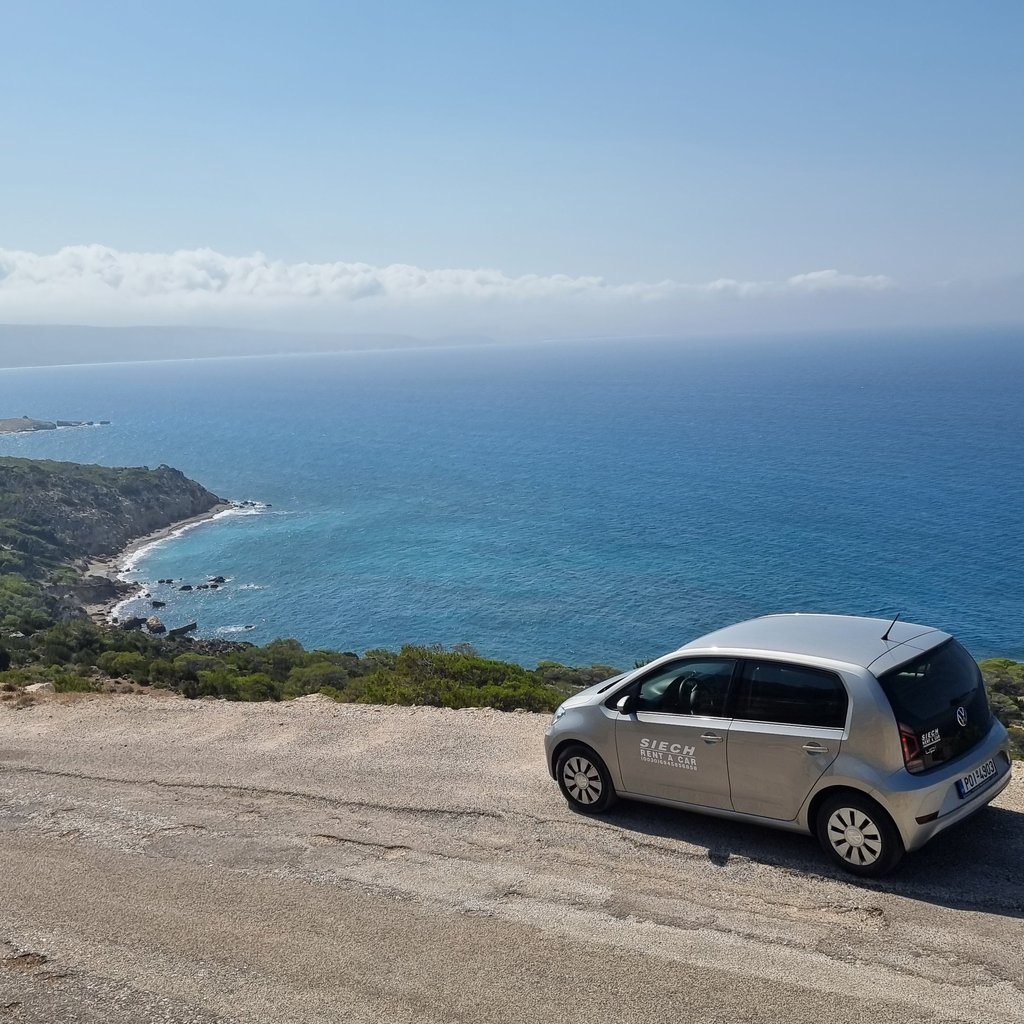
Renting a car for scattered viewpoints
For an independent coastal or hilltop outing, I’d recommend renting a car. It gives you flexibility around walks, beach breaks and changing light, especially around Monolithos, Fourni and Prasonisi.
Before booking, compare live car rental prices for your dates, then compare insurance, excess, fuel terms and collection arrangements. Choose a rental period that covers your return comfortably, not just the drive to your last stop.
Group viewpoints along one coast rather than zigzagging across Rhodes. These routes give you a useful starting point, but they are options to shorten—not lists you must finish.
- East coast: Rhodes Town → Anthony Quinn Bay viewpoint → Lindos Acropolis → St Paul’s Bay. Leave enough room for the walks around Lindos.
- West coast: Rhodes Town → Filerimos Hill → Kritinia Castle → Monolithos Castle → Fourni Beach. Drop stops if you want longer at the castles or beach.
- Far south: Give Prasonisi its own southern outing rather than adding it casually to a northern sightseeing day.
- Remote viewpoints: Arrange your own transport rather than relying on finding a taxi for the return.
Keeping a no-car day simple
Rhodes Town is the simplest choice for a walking-based photo day. Combine Old Town streets and sea gates with Mandraki Harbour, without needing transport between distant coastal stops.
Monte Smith Hill, also called St Stephens, is an optional uphill addition if you are comfortable walking. It is the hill associated with the Acropolis of Rhodes, not a separate destination to count twice.
For a bus outing, choose one main destination and explore around it. Lindos lets you focus on the village, Acropolis and St Paul’s Bay, with uphill walking part of the day.
Use Rhodes bus routes and planning advice to build the journey around your holiday base. East-coast beach outings can work by bus, but reaching a coastal area is not the same as reaching its hilltop viewpoint.
- Best for a relaxed day: Old Town and Mandraki, with breaks whenever you want.
- Best for a focused outing: One bus destination, rather than several connections between viewpoints.
- Less suitable without a car: A chain of remote west-coast cliffs, castles and late-evening stops.
Choosing an outing or an airport transfer
If you want someone else to handle the driving, compare organised excursions with scenic coastal or castle stops. This suits travellers who prefer a set plan, though you have less freedom to linger at a viewpoint.
Choose by the actual itinerary, not just the tour title. Look at pickup arrangements, time at each stop, walking involved and whether entry tickets are included.
Airport transport is a separate decision: book a Rhodes airport transfer if you want a pre-arranged journey to your holiday base. Keep that booking separate from your sightseeing plans, and use the Rhodes Island Guide’s transport overview to decide how you’ll travel during your stay.
Packing and planning the return
Transport schedules and attraction prices can change, so settle your return journey and entry arrangements before setting out. For ticketed sites, match the visit to opening hours rather than planning around the view alone.
If your final stop is remote, plan the drive back as carefully as the outward route. Choose an earlier finish if you would rather avoid unfamiliar roads after dark.
Use safe, legal stopping places and continue on foot where access is permitted. If there is nowhere suitable to stop, skip the photo rather than pulling over on a bend or beside moving traffic.
- Water and a small snack: Carry them for hill walks and longer outings.
- Comfortable shoes with grip: Some viewpoints involve steps or uphill paths.
- Sun protection: Bring sunscreen, a hat and sunglasses.
- Charged phone and saved route: Keep your return details and booking information handy.
- Camera basics: Pack a lens cloth and spare battery or power bank.
- A torch for a late finish: Useful if your outing may end after dark. For the rest of your day bag, see what to pack for Rhodes.
Chapter 8 of 9
Should you visit at sunrise or sunset?
Choose sunrise for east-facing coastal views and sunset for west-facing outlooks. Softer light suits stone, villages and silhouettes; brighter daylight can work better when you want to show water colour.
Sunrise and morning visits
East-facing outlooks are the natural choice if you want the sun rising over the sea. Early light also suits whitewashed villages and medieval stone, while morning visits help you avoid summer heat and busier streets.
I'd choose morning for a quieter outing, even if you miss sunrise itself. Summer haze can reduce distant detail, so earlier visits are often a better choice for wide views. You can choose a sunrise outing around the area where you're staying.
Sunset and late-afternoon visits
Choose a west-facing outlook if seeing the sun drop towards the sea is your priority. Late-afternoon light also brings warmth to castle stone, cliffs and harbour scenes, before silhouettes become the main attraction.
East-coast views can still look beautiful late in the day, even when the sun disappears behind inland hills. Decide whether you want the sunset itself or warm light across the landscape, then choose a sunset spot.
If your return route allows it, linger briefly after sunset for possible pastel skies and blue-hour colour. Those colours vary with conditions, so enjoy the changing view rather than expecting a particular sky.
When daytime light works better
You don't need golden hour for every coastal view. Brighter light can reveal turquoise and emerald water more clearly from above, although glare and conditions affect the result.
Mid-morning is a useful compromise for bay views: more light on the water without building your visit around midday heat. I'd save softer light for village scenes and stonework, and use brighter conditions for beach panoramas.
Chapter 9 of 9
How can you take better photos without taking risks?
Good light and a safe position matter more than finding a risky angle. You can take memorable photos in Rhodes with a phone or camera without climbing walls, approaching cliff edges or blocking paths.
Use the light and keep the composition simple
Early morning gives you soft light, while late afternoon brings warmer colours to stone and coastline. Midday is harder for portraits, but strong sunlight can bring out turquoise water when photographed from above. Summer haze can soften distant views, so favour morning for clearer landscapes.
I'd start with one clear subject rather than trying to fit everything into the picture. For a photo-led outing, choose your stops using the best photography spots in Rhodes.
- Choose a focal point: a chapel, bay, archway or castle silhouette gives the picture a clear subject.
- Use a simple frame: shoot through an accessible archway or include nearby stonework without climbing onto it.
- Add depth: include a foreground rock or wall, with the coastline beyond.
- Keep equipment simple: a phone or one general-purpose camera lens is enough for a holiday outing. Use a wide view for bays and villages, then try a tighter frame for details.
Work around crowds and respect shared spaces
Go early if you want quieter streets, but expect to share popular viewpoints. Wait for a gap rather than asking everyone to move. A tighter frame can leave out distractions without needing an empty scene.
Keep steps, gates and narrow paths clear while you take your shot. Set bags and tripods out of the way, and let people pass between photos. Ask before making someone the main subject, and respect private doorways and courtyards.
Stay back from edges
Choose stable ground well back from cliff edges, and stay behind barriers. Never step backwards while looking at your screen or through the viewfinder. Put the camera down before moving, then check your footing.
Skip any angle that needs loose-rock scrambling, climbing ruins or leaning over a drop. Wind is another reason to step back, not push closer. With children, choose a position away from edges before setting up a family photo.
Wear secure footwear with grip for uneven paths and steps, and carry water if you plan to linger. Photo stops can keep you in the heat longer than expected. Keep the rest of your kit practical with what to pack for Rhodes.
Check drone restrictions before every flight
Before every drone flight in Greece, check Drone Aware Greece (DAGR) for current geographical and temporary restrictions. Yellow and magenta zones may involve conditional permission or prohibition, including around airports and archaeological sites. Read the conditions for your exact location before taking off.
Drone geographical zones apply across all operating categories. Drones must not fly close to or inside an area with an ongoing emergency response.
A viewpoint recommendation never implies permission to fly a drone. A quiet beach or remote hill still needs the same pre-flight restriction check.
Book transport for your viewpoint day
transfersFrequently asked questions
Where are the best views in Rhodes?
Start with Lindos Acropolis, Monte Smith Hill, Monolithos Castle, Kritinia Castle and Filerimos. For bay views, consider St Paul’s Bay, Anthony Quinn Bay and Tsambika.
Are Monte Smith, St Stephens and the Acropolis of Rhodes separate viewpoints?
No. Monte Smith Hill is also called St Stephens and is the location of the Acropolis of Rhodes. Plan them as one stop.
Which viewpoints should I choose for a first visit?
I’d choose one near your base, then add a coastal or castle viewpoint during a day out. You don’t need to cross the island for every good view.
Do I need a car to visit Rhodes viewpoints?
A car is the practical choice for combining scattered coastal and hilltop stops. For an Old Town photography walk, explore on foot instead.
Which area is best for medieval streets and rooftop views?
Choose Rhodes Old Town. The Street of the Knights, Palace of the Grand Master, Roloi Clock Tower and Suleiman Mosque area offer different views of the medieval town.
Is sunrise or sunset better for views in Rhodes?
Choose your spot around its outlook, not just the clock. West-facing views are the natural starting point for sunset, while east-facing coastal views suit sunrise.
Can I combine several viewpoints in one day?
Yes. Keep your stops within one area, such as Lindos or the west coast. I’d leave time for walking and breaks rather than build a long island-wide checklist.
Which viewpoints suit children or travellers avoiding climbs?
Start with street-level Old Town views rather than a hilltop or tower. Check the individual stop’s walking and step requirements before choosing a castle, acropolis or elevated viewpoint.
What should I bring for a viewpoint outing?
Bring water, sun protection and shoes with grip. Keep your hands free on uneven ground, and carry a charged phone for navigation and photographs.
Can I fly a drone at Rhodes viewpoints?
A viewpoint recommendation does not give permission to fly. Check Drone Aware Greece before every flight for current geographical and temporary restrictions. These apply across operating categories. Never fly close to or inside an ongoing emergency-response area.
Related pages
- Rhodes Old Town Guide 2026 — What to See, Eat & Explore
- Best Sunset Spots in Rhodes (2026 Local Guide)
- Anthony Quinn Hill Viewpoint – Is It Worth the Walk? (2026 Guide)
- Anthony Quinn Bay Rhodes (2026) – Is It Worth the Hype?
- Tsambika Beach Rhodes (2026) – Is It Worth the Hype?
- Agia Agathi Beach Rhodes 2026 — Wild Sandy Bay Guide
- Lindos Acropolis – Complete 2026 Visitor Guide (Tickets, History & Tips)
- St Paul’s Bay Lindos (2026) – Is It Worth the Hype?
Planning your complete Rhodes holiday?
Our Island Mega Guide brings together everything you need to plan your Rhodes holiday, from choosing where to stay and finding the best beaches to transport, activities and practical travel advice.
Open the Rhodes Island Guide