
Chapter 1 of 8
What does “clearest water” actually mean?
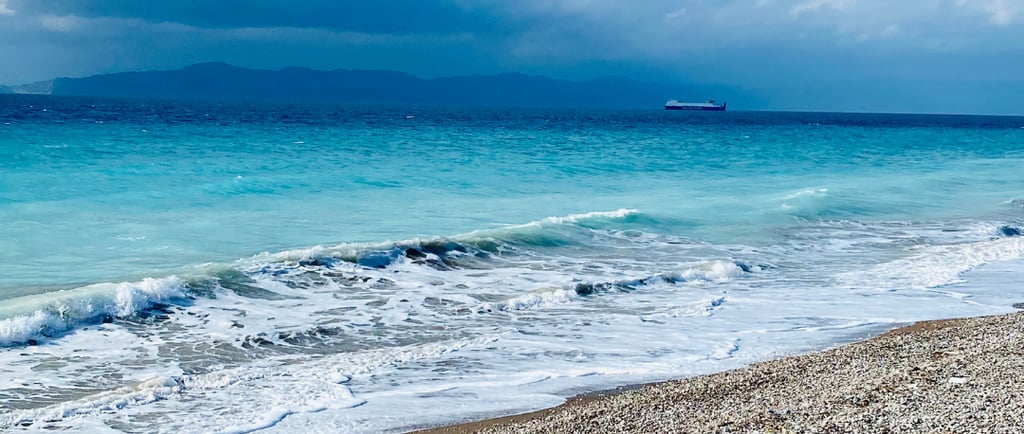
The clearest water in Rhodes can mean three different things: beautiful blue colour from the shore, good visibility beneath the surface, or inviting conditions for a swim. They are not interchangeable: turquoise water can have stirred-up sand beneath it, and transparent water can still be unsuitable for your swimming ability. Here, the comparison is about water colour and clarity—not another overall beach ranking; for sand, facilities and the wider beach-day experience, use our Best Beaches in Rhodes guide.
Blue colour versus underwater visibility
Blue colour is what you see looking across a bay or down from a viewpoint; underwater visibility is how clearly you can see through the water. A bright turquoise shallows and a deep-blue stretch can both be clear, even though they look completely different in photographs. Neither colour tells you whether the entry, depth or sea conditions suit you.
The intensely blue waters around Lindos are a good example of colour appeal, but that alone does not make them the island’s clearest. The useful question is whether you want a striking view, a clear look beneath the surface, or comfortable swimming—and then to compare beaches on that basis.
- Seabed: a light sandy bottom reflects light and can give shallow water a bright turquoise appearance. Rockier seabeds create different colour patterns, while sand stirred into the water can reduce visibility.
- Depth: shallow water over a pale bottom can look luminous; deeper sections can appear richly blue. A darker patch is not automatically murkier water.
- Sunlight: the angle and strength of the light change how the same bay looks throughout the day. Stronger turquoise colour does not necessarily mean better underwater visibility.
- Wind and waves: surface disturbance changes the appearance of the water and can stir up seabed particles. Less disturbance can help visibility, but a sheltered-looking setting is no guarantee of calm conditions.
Why no beach wins every day
There is no useful permanent winner for the clearest water in Rhodes. The same beach can look different as light, wind and wave disturbance change, so a photograph captures a moment rather than a promise. Even a bay known for transparent water will not deliver identical visibility on every visit.
I’d use the beaches in this comparison as a shortlist, not a league table. If your priority is photography, colour and viewpoint matter; if you want to look underwater, visibility matters more. For swimming—especially with children or less-confident swimmers—comfortable conditions and a suitable entry come before either.
Prasonisi makes that distinction particularly important: it experiences strong winds and is a popular windsurfing location. Attractive blue water there is not a reason to expect an easy swim. Choose for the sea in front of you, rather than trying to recreate a photograph.
Chapter 2 of 8
Which bays should you shortlist for striking blue water?
Shortlist Anthony Quinn Bay for dramatic emerald-turquoise colour, Ladiko for a gentler neighbouring bay with beautifully clear water, and Traganou for turquoise-to-deep-blue tones against limestone rocks. My first pick for sheer visual impact would be Anthony Quinn; I’d lean towards Ladiko if a relaxed swim mattered more than the iconic photograph. These are different kinds of blue-water appeal, not a ranking of which beach is always clearest.
Anthony Quinn Bay
Anthony Quinn Bay is the standout choice here for that rich, almost unreal emerald-turquoise look. Its rocky seabed and bowl-shaped setting give the water a saturated colour, with clear-water views that make it especially appealing for photography and looking beneath the surface.
I’d choose it if the setting is a big part of your beach day: the cliffside views are part of the attraction, not just the swim. If you prefer a gentler bay or find it too busy, Ladiko makes a sensible alternative. Use the Anthony Quinn Bay guide for arrival and beach-access planning.
- Best fit: travellers prioritising striking colour, rocky scenery and photographs.
- Worth knowing: morning light is a particular draw; arriving before 10:00 is a photography suggestion, not a guarantee of calm swimming conditions.
Ladiko Beach
Right next to Anthony Quinn, Ladiko has a softer blue palette but wonderfully clear water. Its sheltered setting, underwater sand patches and shallow-to-deep gradient give it a gentler character than its more dramatic neighbour.
I’d favour Ladiko if you want the clear-water experience without making the famous viewpoint the centre of your visit. It can be slightly less busy than Anthony Quinn, and the two are close enough to walk between. See Ladiko Beach for detailed access and beach-day planning.
- Best fit: swimmers who prefer a gentler-feeling bay and softer blue tones.
- Worth knowing: the water progresses into deeper sections, so choose your swimming area to suit your confidence.
Traganou Beach
Traganou, in the Afandou area, belongs on the shortlist for its mix of turquoise and deep blue, with limestone rocks reflecting the sunlight. Its clear water and rocky features make it an appealing alternative if geology and underwater scenery interest you more than Anthony Quinn’s iconic setting.
For children, less-confident swimmers or anyone needing straightforward access, check the entry surface, depth and route onto the beach before settling on your spot. Use the Traganou Beach guide for visit planning, and judge shelter and underwater visibility on the day rather than choosing by colour alone.
- Best fit: travellers drawn to limestone scenery and contrasting shades of blue.
- Worth knowing: choose it for its landscape and clear-water appeal, rather than expecting the same enclosed-bay experience as Ladiko.
Chapter 3 of 8
Which Lindos beach gives you the setting you want?
Choose St Paul’s Bay for its lagoon-like setting, or Lindos Main Beach if soft sand is the deciding factor. Lindos’s intensely blue waters make both appealing stops for a colour-focused beach day, but that colour alone doesn’t make either the clearest beach in Rhodes. I’d choose between them by the setting and shore you want, rather than expecting one to win on underwater visibility.
St Paul’s Bay
St Paul’s Bay is the choice for a beach day built around the view: a bay with a lagoon-like appearance and a sandy seabed that contributes to its luminous colour. It particularly suits couples and travellers who care as much about the setting as the swim. Early morning light can give the water a lovely glow, making it an appealing time for photographs.
I’d pick it over Lindos Main Beach when the bay setting is the main attraction; if your priority is settling onto soft sand, Main Beach is the more straightforward choice. The swimming-pool look is a visual impression, not a promise of calm or safe swimming, so let the conditions on the day guide you. For access and the practical details of a visit, use the full St Paul’s Bay guide.
Lindos Main Beach
Lindos Main Beach offers soft sand and a bright sandy bottom—the combination to choose if you want the shore itself to be part of the appeal. Its colour changes with the light: morning can bring softer, golden tones, while stronger midday light can bring out bright turquoise. That makes it a good alternative to St Paul’s when a sandy beach day matters more than the lagoon-like setting.
If you’re travelling with children who want to play on the sand, I’d lean towards Main Beach for that reason. That recommendation is about the shore, not a claim that swimming is safer here. For comparisons based on sand, setting and beach-day preferences elsewhere on the island, the Rhodes Island Guide’s beach chooser is a useful next step.
Chapter 4 of 8
Tsambika or Stegna for turquoise water?
Choose Tsambika for a wide, sandy bay with luminous aqua-turquoise water; choose Stegna for clear water beside a mixed sand-and-pebble shore with rocky edges. I’d make this choice on the beach setting you enjoy, rather than expecting either beach to guarantee better underwater visibility.
Tsambika’s wide bay and aqua tones
Tsambika’s appeal is the broad sweep of the bay and the bright aqua tones over its golden sandy bottom. Midday light can bring out that luminous turquoise colour, making it a strong choice if your ideal beach scene is sand and an expansive stretch of blue water.
I’d lean towards Tsambika for a family beach day or a leisurely visit built around swimming and relaxing on sand. It is the better match here if you prefer a wide-bay setting to rocky shoreline details; if you’re still deciding which shore type suits you, the Rhodes Island Guide’s beach chooser helps put that preference first.
- Choose it for: a wide sandy setting, aqua-turquoise tones and a full beach day.
- Choose Stegna instead if: rocky edges and a more varied shoreline are part of the attraction.
Stegna’s clear water and rocky edges
Stegna pairs clear water with a mixture of sand, pebbles and rocky edges. The attraction is that contrast between the water and the natural shoreline, rather than Tsambika’s broad sandy sweep.
I’d choose Stegna if you enjoy a mixed shore and want rocks to be part of the view, but not if sand underfoot is your main priority. Early-morning light is particularly appealing here for seeing sunlight through the water, without making it a promise of better swimming conditions.
For facilities and detailed arrival planning, use the Stegna Beach guide. My suggestion: pick Stegna for shoreline variety, or Tsambika for the wide-bay turquoise picture—neither needs to win a clarity contest to be the right beach for you.
Chapter 5 of 8
Would Haraki or Kiotari suit you better than a small cove?
Yes—choose Haraki if you want a relaxed, semi-circular bay, or Kiotari if a long shoreline and rich deep-blue tones appeal more than a tightly framed cove photograph. Their role in this shortlist is about atmosphere: Haraki offers a more contained bay setting, while Kiotari gives you a broader stretch of coast in south Rhodes. Neither needs to win a clearest-water ranking to be the better beach day for you.
Haraki’s bay setting
Haraki’s appeal is its peaceful character and the curve of the bay, with clear water that can look wonderfully glassy in settled conditions. The gradual increase in depth adds to its appeal for an unhurried swim, though the actual waves and entry conditions still matter on the day.
I’d choose Haraki if the aim is to spend time in the water and enjoy a relaxed setting, rather than chase the island’s most recognisable beach photograph. It is a good fit for someone who likes the shape and intimacy of a bay without making dramatic scenery the whole point of the visit.
If your priority is a long, open shoreline, Kiotari is the more natural choice of these two. For access and the details needed to plan a visit, use the full Haraki Beach guide.
Kiotari’s long shoreline and deeper-blue tones
Kiotari offers a different visual mood: a long shoreline in south Rhodes, with rich ultramarine and sapphire tones rather than just the pale turquoise associated with small sandy bays. Its quieter character is part of the attraction, but that describes the general atmosphere—not a promise of an empty beach wherever you stop.
My suggestion: choose Kiotari when you want the coastline itself to be the backdrop, rather than a compact cove enclosed around you. If that enclosed-bay feeling is what you love, Haraki will probably suit you better.
The deeper blue is a description of colour, not a way to judge swimming depth or the ease of entry; assess your chosen stretch at the water’s edge. To see how the area fits your plans, use the Kiotari section of the Rhodes Island Guide.
Chapter 6 of 8
When should swimming conditions overrule the photograph?
Swimming conditions should always overrule the photograph. Even the clearest water in Rhodes can be unsuitable for your group on the day: bright turquoise colour and a visible seabed tell you nothing dependable about how easy the swim—or the return to shore—will be. Choose the view you like, then make the swimming decision when you arrive.
Choose your swim by conditions, not colour
Keep three things separate: how blue the water looks, how clearly you can see underwater, and whether the conditions suit your swimming ability. A beautiful photograph answers only the first question, while clear visibility is just one part of what you encounter in the sea.
Before getting in, take a moment to assess the actual water rather than heading straight towards the best-looking patch. Follow local flags, signs and lifeguard instructions wherever they are present; if you are unsure about conditions, ask locally and stay out until you have a clear answer.
- Look at the wind and waves on arrival, including what is happening beyond the water’s edge. If conditions look challenging, change the plan rather than trying to make the swim match the photograph.
- Check where you can enter and leave the water comfortably, and how quickly it gets deeper. Seeing the bottom clearly is not a dependable way to judge depth.
- For children and less-confident swimmers, prioritise manageable conditions, straightforward entry and exit, and close supervision over striking colour. No whole beach gets a blanket safety label.
- If the sea changes while you are swimming, head back to shore rather than pushing on to a photogenic rock or deeper-blue patch.
Why Prasonisi is a wind-exposure caution
Prasonisi experiences strong winds and is a recognised windsurfing location. That makes it relevant to windsurfing plans, but I would leave it outside a shortlist for relaxed, calm-water swimming—particularly with children or less-confident swimmers.
A “calm side” label or an early arrival is no guarantee of a safe swim. If swimming is the priority, use the Rhodes Island Guide’s beach-choice advice and the Rhodes beach comparison to choose alternatives, then make the final decision from the conditions you find.
Chapter 7 of 8
How should you time and prepare your visit?
Choose your visiting time for the light and the kind of beach day you want—not a promised hour of perfect visibility. Changing sunlight can make the same bay look softly blue, bright turquoise or much darker, while arriving in the morning is no guarantee of clearer water. Bring drinking water, sun protection and footwear suited to the shoreline, with a mask and snorkel if you want to look beneath the surface.
Light, photographs and realistic expectations
For photographs, think of light as part of the setting rather than a measure of water clarity. Morning light can give the water a softer, warmer appearance; stronger midday sunlight can bring out bright turquoise over sandy shallows. Later shadows can make the same water look deeper blue without any corresponding change in underwater visibility.
Lindos Main Beach is a useful example: its colour can shift from warm morning tones to brighter turquoise around midday. Rocky coves such as Anthony Quinn Bay offer a different palette of blue and emerald. A photograph captures one combination of light, viewing angle and conditions—not a colour you are guaranteed to find on arrival.
My suggestion: choose a morning visit if you like softer light, but keep your swimming plans flexible. There is no universal best hour, month or season for the clearest water in Rhodes, and an early start alone cannot promise better visibility. For broader holiday timing, use the Rhodes Island Guide’s planning advice rather than choosing travel dates around a guaranteed clear-water season.
What to bring for your chosen shoreline
Pack for the beach under your feet as well as the water in the photograph. A sandy shore and a mixed sand-and-pebble beach such as Stegna call for different footwear, particularly if you find pebbles uncomfortable.
- Drinking water: bring enough for your planned visit rather than relying entirely on buying it when you arrive.
- Sun protection: pack sunscreen, a hat and sunglasses. Apply and reapply sunscreen according to its instructions, including after swimming; never delay it in pursuit of clearer water.
- Suitable footwear: bring shoes for the walk to the beach and consider water shoes for pebble or rocky entries.
- Swimming essentials: bring swimwear and a towel, plus a mask and snorkel if seeing below the surface is part of the appeal.
Chapter 8 of 8
What is the easiest way to compare beaches in one day?
For comparing several beaches in one day, a rental car is the simplest choice if you’re comfortable driving—but keep the shortlist small. I’d choose two beaches close together, leave a third optional, and spend more time swimming than moving between stops. If you only want one beach, there’s less reason to hire a car just for the day. I compare all the main beaches coast by coast in my guide to the best beaches in Rhodes.
When renting a car makes sense
A car makes sense when you want to choose your own departure time, carry beach gear and change plans without fitting each stop around a bus service. My suggestion: compare Rhodes car rental options if visiting several beaches is the main purpose of your day, rather than an optional extra.
Before booking, compare the practical terms as well as the headline price. The Rhodes Island Guide’s car-rental advice is a useful starting point.
- Check the collection and return arrangements against the beach day you actually want.
- Read the insurance, excess, deposit and fuel terms, and confirm any additional-driver or child-seat requirements.
- If you’d rather not drive, use the Rhodes bus guide to check seasonal services and your return journey before choosing the beaches.
Keeping the route manageable
Anthony Quinn Bay and Ladiko are a sensible compact comparison: the source’s shortlist places them right next to each other, so you can compare two bays without building a long coastal itinerary. Start with the Anthony Quinn Bay guide for detailed visit planning, then decide which bay deserves most of your swimming time.
For any other combination, plot the route from your starting point before committing to it. Don’t turn the full clear-water shortlist into a single-day checklist; a long sequence of stops can leave you with plenty of photographs and very little beach time.
- Choose two priority beaches and make any third stop optional.
- Check the actual driving route rather than judging convenience by how close beaches look along the coastline.
- Allow room for swimming and lunch instead of scheduling each stop back-to-back.
- If the first beach suits you, stay longer—there’s no prize for completing the shortlist.
Keeping beach transport separate from airport transfers
Airport transport is a separate booking decision. If you also need an arrival or departure ride, compare Rhodes airport transfers for that journey—not for transport between beaches.
If you prefer to compare transport arrangements in one place, the Rhodes Booking Marketplace is an alternative starting point. Use its car-rental category for a self-drive beach day, keeping the dates and collection arrangements separate from any airport-transfer booking.
Booking transport for a beach-comparison day
Frequently asked questions
Which beaches in Rhodes have the clearest water?
Anthony Quinn Bay, Ladiko, the Lindos beaches, Tsambika, Stegna and Haraki belong on the shortlist. There is no fixed clarity ranking: compare the conditions when you arrive rather than expecting one beach to win every day.
Where is the bluest water in Rhodes?
Lindos is a strong starting point for intensely blue water. Anthony Quinn Bay is another colour-focused choice, while Tsambika is better matched to someone looking for aqua-turquoise tones.
Does turquoise water mean better underwater visibility?
No. Surface colour and underwater visibility are different qualities. A beach can look beautifully turquoise without giving you the clearest view beneath the surface.
Is Lindos definitely the clearest swimming spot on the island?
Lindos has intensely blue water, but that does not make it a guaranteed winner for underwater clarity. Choose between its beaches for the setting you prefer, then assess the swimming conditions on the day.
Which beach should I consider for soft sand and blue water?
Lindos Main Beach is a useful starting point for soft sand and blue water. Tsambika is another option if a wide bay and turquoise appearance matter more to you than a small-cove setting.
Is Prasonisi a good choice for reliably calm, clear swimming?
I would not choose Prasonisi for a reliably calm swim. It experiences strong winds and is a popular windsurfing location; attractive water colour is not a reason to overlook the conditions.
Is early morning guaranteed to give the clearest water?
No. Light changes how the sea looks, but an early start does not guarantee clear, calm or safe water. In particular, morning is not a reliable workaround for wind exposure at Prasonisi.
Do I need a car to compare several beaches?
For a day comparing several beaches, I’d recommend a car rather than building the day around multiple transport connections. Keep the shortlist manageable and compare Rhodes car rental options if that suits your plans.