
Chapter 1 of 8
Which Rhodes beach sections hold Blue Flag awards in 2026?
The official 2026 list for the Municipality of Rhodes contains 28 awarded sections. Here is the full list, grouped by the area names used in the entries. Each hotel reference identifies a particular awarded section, not a private beach or an award for the entire surrounding coastline.
Faliraki, Afandou, Kolymbia, Ialyssos, Ixia and Reni 1 (Kallithea)
These 12 entries retain their full official names, including the numbered sections and hotel references. Galouni Kokkinogia (Kolymbia) – Boutique 5 Hotel appears with the other Galouni Kokkinogia entries below, retaining the wording of the award list.
- Faliraki — 4 sections: Faliraki/Ammoudes – Mitsis Selection Alila; Faliraki/Ammoudes – Elysium Resort; Faliraki/Ammoudes – Rodos Palladium; Faliraki 2 – Amada Colossos.
- Afandou — 2 sections: Afandou 2 – Irene Palace; Afandou 2 – Port Royal.
- Kolymbia — 3 sections: Kolymbia A-Limanaki – Atlantica Imperial; Kolymbia – Mythos Beach; Kolymbia – Mikri Poli.
- Ialyssos — 1 section: Ialyssos – The Ixian Grand.
- Ixia — 1 section: Ixia – Amus.
- Reni 1 (Kallithea) — 1 section: Reni 1 (Kallithea) – Sunwing Kallithea Beach.
Vlycha, Psaltos, Galouni Kokkinogia and the remaining awarded areas
These 16 entries complete the total of 28. Source: Hellenic Society for the Protection of Nature, announcement of 14 May 2026. The 2026–2027 award is a single transitional two-year award, with annual checks continuing.
For planning beyond the award names, use the Afandou Beach guide or the Rhodes Island Guide’s beach section. Keep the full awarded-section name handy when choosing your destination.
- Vlycha — 2 sections: Vlycha – Lindos Grand Resort; Vlycha – Lindos Mare & Lindos Blu.
- Psaltos — 1 section: Psaltos – Lindian Dream Resort Hotel.
- Galouni Kokkinogia — 4 sections: Galouni Kokkinogia (Kolymbia) – Boutique 5 Hotel; Galouni Kokkinogia – Mayia Exclusive Resort; Galouni Kokkinogia – Mitsis Rodos Village; Galouni Kokkinogia – Princess Adriana Resort.
- Gennadi — 1 section: Gennadi – Gennadi Grand Resort.
- Kiotari — 2 sections: Kiotari – Lindos Imperial Resort; Kiotari 3 – Rodos Princess Beach.
- Lardos — 2 sections: Lardos 1 – Lindos Princess Beach; Lardos 3 – Lindian Village.
- Lachania — 1 section: Lachania – Atrium Prestige.
- Megali Gi — 1 section: Megali Gi – Atlantica Dreams Resort.
- Plimmiri — 1 section: Plimmiri – TUI Magic Life Plimmiri by Atlantica.
- Reni Kalathou — 1 section: Reni Kalathou – Atrium Palace.
Chapter 2 of 8
Does the award cover the whole beach?
No—not automatically. All 28 Rhodes awards in the 2026 list identify hotel-fronted sections. For example, Afandou 2 – Irene Palace and Afandou 2 – Port Royal are two named entries, not an award covering all of Afandou. The same distinction applies throughout the list.
Beach names versus awarded sections
I keep three things separate: the place travellers call a beach, the name in the award list and the section covered by that award. They are related, but they are not interchangeable.
A hotel name helps identify the awarded section. It does not mean you must stay at that hotel to use the public beach, nor does it give beach visitors automatic use of the hotel's sunbeds or other facilities.
- Destination name: the broader beach or coastal area used in travel guides and navigation searches.
- Exact award name: the complete entry in the 2026 list, including its section identifier and hotel reference.
- Certification extent: the named beach section covered by that entry, not neighbouring shoreline or the whole destination.
Finding the section named in the record
Start with the complete award name when planning your arrival. A map point helps you locate a place, but a point alone does not draw the boundaries of the awarded section.
These are public beaches anyone may use in Greece. If your planned route goes through hotel grounds, ask for the public beach approach rather than assuming that public shore access includes a right to walk through every part of the property.
The Afandou Beach guide and Faliraki Beach guide can help you plan a day in those destinations. Their broader beach descriptions do not enlarge the named sections in the 2026 award list.
Chapter 3 of 8
What does Blue Flag certification require?
Blue Flag certification requires "Excellent" bathing-water quality alongside standards for environmental management, environmental education and information, safety and services. The award is about both assessed water quality and how the beach is managed—not simply how clear or inviting the sea looks.
For the full certification requirements, use the Blue Flag programme materials from the Foundation for Environmental Education and the Hellenic Society for the Protection of Nature. These explain the programme's rules, independently of hotel descriptions or beach promotion.
Excellent bathing-water quality
"Excellent" bathing-water quality is an eligibility requirement, supported by water sampling and testing. A beautiful turquoise colour or a clearly visible seabed is not a substitute for that assessment.
Visual clarity and certified bathing-water quality answer different questions. Our guide to clear-water beaches in Rhodes focuses on appearance and visibility; Blue Flag certification requires more than an attractive-looking sea.
Cleanliness, organisation and visitor information
The requirements extend onto the shore. Excellent water quality alone is not enough: the awarded section also needs to meet the programme's management and information standards.
The useful distinction is between a beach that merely looks tidy and one that meets criteria covering how it is maintained, managed and explained to the people using it.
- Cleanliness: shoreline upkeep and waste management that meet the programme's requirements.
- Organisation: environmental management of the awarded beach section.
- Visitor information: bathing-water information, environmental information and education.
Safety and coastal environmental protection
Safety and services, along with protection of the coastal environment, are part of certification. They sit alongside water quality and cleanliness rather than being optional extras.
Do your part by taking rubbish away, using recycling points where provided, respecting wildlife and avoiding trampling coastal vegetation. Follow posted guidance and lifeguard instructions.
My suggestion: use certification as one part of your decision, then match the beach to the day you want. The Rhodes Island Guide’s beach-selection advice helps with that next step without turning the award into a ranking of the island's beaches.
Chapter 4 of 8
Does a Blue Flag mean easy, safe swimming?
No—a Blue Flag does not guarantee shallow water, calm conditions or risk-free swimming. The award recognises "Excellent" bathing-water quality and standards that include safety, but it is not a rating of how easy the sea is to swim in. Choose your spot around the entry, the conditions that day and the least-confident swimmer in your group.
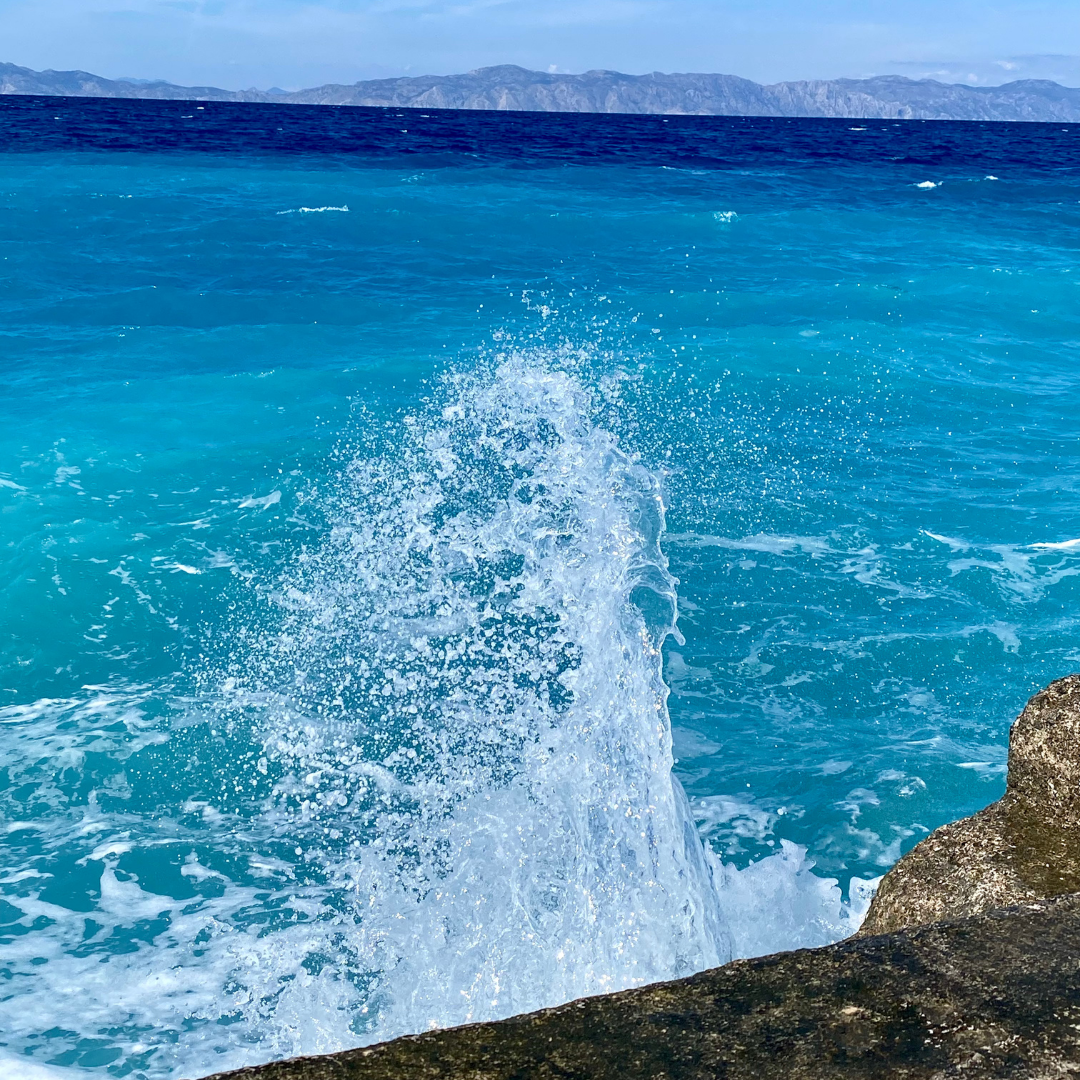
Water depth, waves and swimming ability
Clean water and easy swimming are different things. Certification does not require every awarded section to have a gently sloping seabed, and it cannot promise a wave-free visit.
I'd assess the water in front of you rather than let the flag make the decision. Being able to see the seabed does not mean you can stand on it.
- Water depth: assess how quickly the bottom drops away where you intend to enter.
- Waves and conditions: watch the sea before entering and follow posted swimming warnings or lifeguard instructions.
- Swimming ability: choose conditions everyone can manage comfortably, not just the strongest swimmer.
Afandou: two awarded sections, not a swimming-depth guarantee
The 2026 awards at Afandou are Afandou 2 – Irene Palace and Afandou 2 – Port Royal. Those entries identify the certified sections; they do not describe the seabed gradient or certify the whole beach.
For paddling with young children or staying within standing depth, assess the entry and depth at your intended spot. I would put a suitable entry ahead of award status for that kind of beach day.
Use the Afandou Beach guide for destination planning. Once there, assess your intended entry point before deciding where to swim.
Choosing for children and less-confident swimmers
Let the least-confident swimmer set the requirements for your beach choice. If someone needs shallow water to feel comfortable, make a suitable entry and manageable conditions essential.
For help matching a beach to your group, use the Rhodes Island Guide’s beach-choice advice. Keep certification and swimming suitability as separate questions: both matter, but one cannot answer the other.
- Before settling down, look for an entry and exit that everyone in your group can use comfortably.
- For paddling, choose water that stays shallow over a useful area rather than relying on the appearance of the shoreline.
- Keep children closely supervised in and around the water; an award does not replace supervision.
- If the waves or depth feel beyond someone's ability, choose another spot or stay out of the water.
Chapter 5 of 8
Will an awarded section have the facilities you need?
Not necessarily. Blue Flag includes safety and service criteria, but the award is not a promise of every facility you personally need. Check the exact section's approach, toilets, sea-entry arrangements and services rather than choosing by the flag alone.
Step-free access and assisted sea entry
Reaching the beachfront, crossing the shore and getting into the sea are three separate parts of the journey. If you use a wheelchair or have limited mobility, I'd choose arrangements that match your needs rather than relying on the award alone.
Use the accessible Rhodes beach guide to explore access options; it is an accessibility resource, not the 2026 award list. Then ask the operator about your intended visit, including equipment availability and operating arrangements.
- Approach to the shore: Is there a continuous step-free route from the drop-off point or parking area? Ask about slopes, surfaces and where any firm path ends.
- Accessible toilets: Where are they relative to your chosen spot, and will they be open and available to you?
- Assisted sea entry: Is equipment available and operating? Ask how it is used, whether assistance is provided and whether advance arrangements are needed.
Lifeguards, toilets and beach services
If lifeguard cover matters to your choice, establish the staffed area and duty times for the section you plan to use. The award is not a promise that a lifeguard will be on duty wherever or whenever you arrive.
For another destination to consider, see Elli Beach. Elli is not on the 2026 award list; assess its facilities and suitability separately from Blue Flag status.
- Safety provision: Ask what cover is provided, which section it serves and during which hours; follow the guidance displayed on arrival.
- Toilets and changing: Ask about location and availability, including any accessibility requirements.
- Shade and seating: Check sunbed and umbrella availability and charges if these matter to your day.
- Food and drinks: Ask about refreshments near your intended section, especially if walking farther would be difficult.
Access at hotel-managed sections
Every 2026 awarded section in Rhodes is hotel-fronted, but these are public beaches anyone may use in Greece. You do not need to be a hotel guest to use the beach. Sunbeds may belong to the hotel, and public beach access does not automatically include hotel grounds or facilities.
My suggestion: separate the free use of the public shore from any service you want to buy. If a particular facility is essential, ask the hotel about access and arrangements for your dates before planning your day around it.
- Public beach access: Ask which public approach to use if you are not staying at the hotel.
- Facility use: Ask which toilets, changing facilities, sunbeds or accessibility equipment are available to non-residents.
- Charges and reservations: Ask about charges or reservations for hotel-owned sunbeds and other optional services—not permission to use the public beach.
- Hotel guests: Ask whether your booking includes the beach services you need or whether any are charged separately.
Chapter 6 of 8
What if a beach has no Blue Flag?
Tsambika, Agathi, Anthony Quinn, St Paul's Bay, Lindos main beach and Elli are not on the 2026 Rhodes award list. That says nothing bad about their water. I would not rule out a public beach simply because it is absent from the list of 28 hotel-fronted awarded sections. If you want to compare beaches around Rhodes with or without an award, my Rhodes beach guide is the best place to start.
A missing award is not a water-quality verdict
An award list records successful certifications; it is not a bathing-water report for every beach in Rhodes. A missing name does not establish poor water quality or tell you whether the beach applied.
The list alone also does not explain any particular absence. There is no reason to infer failed tests, missing facilities or a decision not to apply from non-inclusion.
Use Blue Flag status as one useful piece of information rather than a reason to dismiss every unlisted beach. The Rhodes Island Guide’s beach-choice section helps with a different question: which kind of beach suits your day?
Certification versus visibly clear water
Water that looks transparent and water that meets certified bathing-water standards are different things. Blue Flag's "Excellent" requirement concerns assessed quality, not how turquoise the sea looks or how clearly you can see the bottom.
A photograph or a clear view through the water cannot replace testing. Equally, the award list is not a ranking of Rhodes' most visually impressive water, and a beach's absence says nothing about its appearance.
If your question is where to find beautifully clear-looking water, use the guide to Rhodes' clearest water. It focuses on appearance and visibility—not certification—and inclusion there does not imply a Blue Flag award.
Chapter 7 of 8
Where can you plan a visit to your chosen beach?
Use the individual beach guides to plan your day, then choose transport around your starting point and the stops you want to make. A single beach visit and a multi-beach outing need different plans—you do not need to hire a car simply because you are choosing an awarded section.
Use destination guides for the beach day
If you are considering Elli, start with the Elli Beach guide, keeping in mind that Elli is not on the 2026 list. For Faliraki, use the Faliraki Beach guide alongside the four named Faliraki entries above.
These guides help with the visit; the full 2026 list identifies the awarded sections. My suggestion: choose the beach that fits your group's swimming needs and preferred surroundings, then work out the journey.
Choose transport for your actual itinerary
Start with the Rhodes Island Guide's transport advice to compare the wider options. For one beach day, focus on getting there and back; for several stops, flexibility becomes more useful.
- For a multi-beach itinerary, compare Rhodes car rental options. I'd favour a car if choosing your own stops and departure times is the priority.
- When arranging arrival transport to your chosen base, compare Rhodes airport transfers. Confirm the accommodation or exact drop-off point before booking.
- If you want a separately arranged journey, explore transfer options and confirm the requested pickup, destination and return.
- If you are comparing services for the same trip, use the Rhodes Booking Marketplace to review options that fit your itinerary.
Chapter 8 of 8
How does the 2026–2027 award period work?
The 2026 awards cover a transitional two-year period, 2026–2027. Annual checks continue throughout that period; the longer award term does not remove the requirement to meet Blue Flag standards. Greece's 2026 total is 624 awarded beaches, second worldwide among 51 countries.
- Rhodes total: 28 awarded sections in the Municipality of Rhodes.
- Source and announcement date: Hellenic Society for the Protection of Nature, 14 May 2026.
- Award period: a single transitional two-year award for 2026–2027, with annual checks continuing.
Keep the exact awarded-section name
The Hellenic Society for the Protection of Nature is the source for the Greek award list, while the Foundation for Environmental Education runs the international Blue Flag programme. Use the complete entry when looking up a section, including its number and hotel reference.
Keep that name separate from the broader destination. A guide such as Afandou Beach helps you plan a visit, while the two Afandou 2 entries identify the awarded sections.
Annual checks continue
The two-year award is not an exemption from continuing compliance. Annual checks remain part of the 2026–2027 arrangement, and later official status notices matter when planning a visit.
For your beach day, pair the award information with local safety guidance and the conditions in front of you. The Rhodes Island Guide’s beach-choice advice helps you choose beyond certification alone.
Arrange transport to your chosen beach
transfersFrequently asked questions
Which award season does this Rhodes Blue Flag beaches page cover?
This page covers the 28 awarded sections in the Municipality of Rhodes announced by the Hellenic Society for the Protection of Nature on 14 May 2026. The 2026–2027 award is a single transitional two-year award, with annual checks continuing.
What does Blue Flag certification mean for beaches in Rhodes?
Eligibility requires "Excellent" bathing-water quality and compliance with criteria covering beach management, environmental education and information, safety and services. It is more than an assessment of how clear the sea looks.
Does a Blue Flag award cover the whole beach?
Not automatically. Every 2026 Rhodes award applies to a named hotel-fronted section, not the whole beach or neighbouring shoreline. These are public beaches anyone may use in Greece; sunbeds may belong to the hotel, and hotel facilities are separate from public beach access.
Are Blue Flag beaches always safe for children?
No. Certification does not guarantee shallow water, calm conditions or risk-free swimming. Choose a swimming spot that matches your children's ability, follow local safety instructions and supervise them closely.
Why is Afandou an example of certification's limits?
The 2026 list includes Afandou 2 – Irene Palace and Afandou 2 – Port Royal. Those awards recognise the named sections and the programme's standards; they do not certify all of Afandou or guarantee a gentle entry into the sea. Assess depth and conditions at your intended swimming spot.
Does Blue Flag certification guarantee wheelchair access?
It does not guarantee that every awarded section has the particular access arrangements you need. Ask about the route to the shore, accessible toilets and any assisted sea-entry equipment at the section you plan to use.
Is a beach without a Blue Flag dirty?
No. Tsambika, Agathi, Anthony Quinn, St Paul's Bay, Lindos main beach and Elli are not on the 2026 Rhodes list, but that says nothing bad about their water. Absence from the list does not establish poor water quality or tell you whether a beach applied.
Is Blue Flag the same as having the clearest water?
No. Blue Flag certification includes assessed bathing-water quality and management criteria, while visible clarity describes how the water looks. Neither visible clarity nor an award guarantees suitable swimming conditions for every traveller.