


Ancient Foundations & The Colossus Myth
Before Rhodes Town became the island's capital in 408 BCE, three powerful city-states—Lindos, Ialysos and Kamiros—defined ancient Rhodes. Visiting the Acropolis of Lindos or the atmospheric ruins of Kamiros on the west coast offers a direct connection to this early history. It’s a story separate from the medieval Old Town most visitors know.
As for the Colossus, it’s essential to approach it as a fascinating story, not a destination. Built to honour the sun god Helios, the giant bronze statue was a wonder of the ancient world before an earthquake destroyed it in 226 BCE. No part of it survives, and its location is unconfirmed; the popular image of ships sailing between its legs is a much later invention.
Medieval Defences: Beyond the Old Town
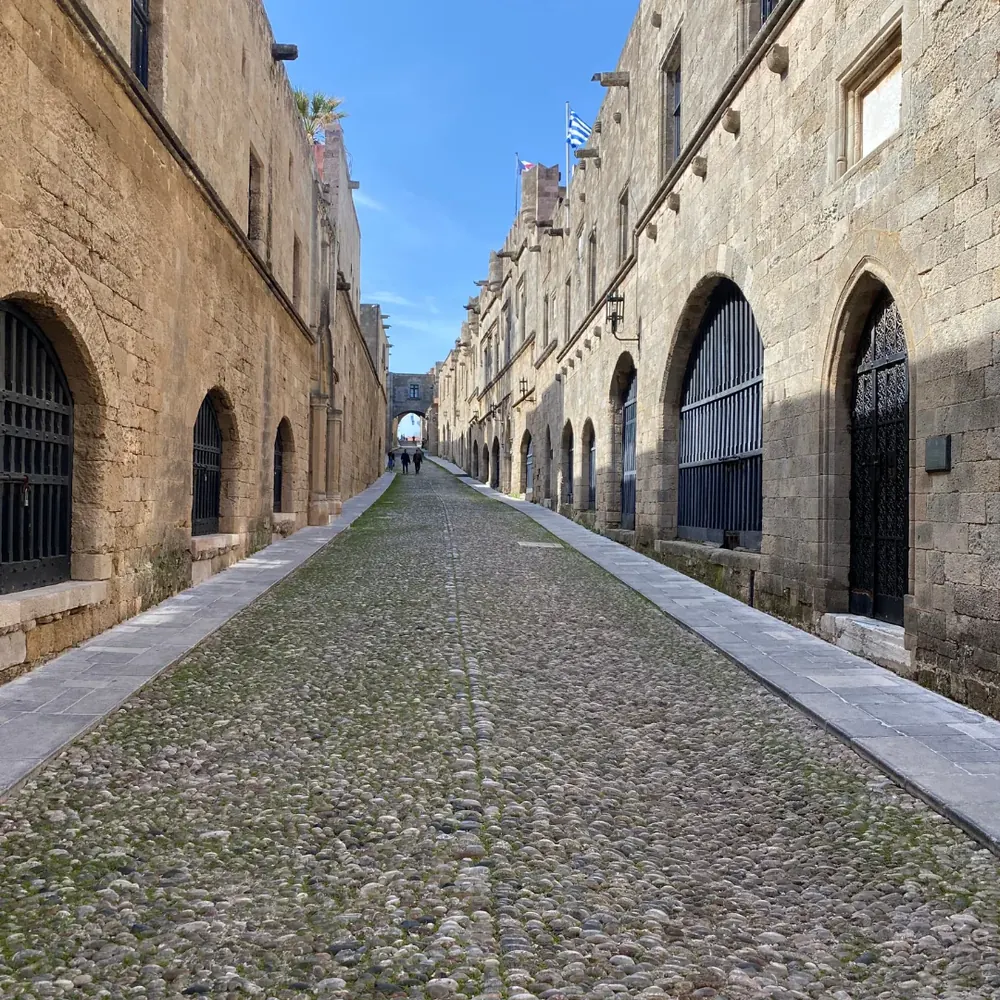
The Knights of St John famously fortified Rhodes, but they built upon earlier foundations. The Old Town's defensive layout began to take shape in the late Byzantine period, a detail that makes a walk along the walls a journey through successive eras of defence.
For a different perspective on fortifications, head to Monolithos Castle on the south-west coast. Built by the Knights in 1476, its power comes from its dramatic setting, where the sheer rock face forms a natural part of its defensive system. It’s a striking example of military architecture adapting to the landscape.
A Later Chapter: Kallithea Springs
For a glimpse into the island’s 20th-century past, Kallithea Springs offers a complete change of scene. Developed by the Italian administration as a thermal spa, it is now a restored cultural monument. With its distinctive rotunda, mosaic floors and landscaped courtyards, it represents a unique architectural style on Rhodes. Below the historic buildings, a sheltered cove provides a place for a swim.
Related Rhodes guides
Next, read our local guides to Acropolis of Lindos, ruins of Kamiros and Monolithos Castle. Check the details of the specific place or listing before you book, as general island advice will not fit every trip.
Frequently asked questions
Can I see the Colossus of Rhodes?
No parts of the Colossus survive today. While its story is a key part of Rhodes' history, there are no ruins to visit and its exact location remains unconfirmed. The deer statues at Mandraki Harbour are modern symbols, not ancient markers.
Which historical sites are best for ancient history?
Prioritise the Acropolis of Lindos and the ruins of Ancient Kamiros. These sites connect you directly to the island's pre-capital city-states. The Colossus should be treated as a historical account, not a physical site to be ticked off a list.
How can I combine seeing castles and fortifications?
For a comprehensive look at the island's defences, pair a tour of the Old Town's layered walls with a visit to Monolithos Castle. This allows you to contrast the capital's immense fortifications with a remote castle that uses the natural landscape for its strength.
Is there a historical site that's also good for swimming?
Yes, Kallithea Springs. The restored Italian-era spa complex has steps leading down to a sheltered swimming cove, making it the ideal choice for a visit that blends early 20th-century architecture with time by the sea.